place

Lubyanka (Moscow Metro)

Moscow Metro stationsRailway stations in Russia opened in 1935Railway stations located underground in RussiaSokolnicheskaya Line
MoscowMetro Lubyanka 5871

Lubyanka (Russian: Лубя́нка) is a station on the Sokolnicheskaya Line of the Moscow Metro, located under Lubyanka Square. The facility, originally called Dzerzhinskaya (Russian: Дзержинская) station, opened in 1935 as part of the first stage of the metro.

Excerpt from the Wikipedia article Lubyanka (Moscow Metro) (License: CC BY-SA 3.0, Authors, Images).

Lubyanka (Moscow Metro)
Lubyanskaya Sq, Moscow Tverskoy District

Geographical coordinates (GPS) Address Nearby Places
placeShow on map

Wikipedia: Lubyanka (Moscow Metro)Continue reading on Wikipedia

Geographical coordinates (GPS)

Latitude Longitude
N 55.7597 ° E 37.6272 °
placeShow on map

Address

Лубянка

Lubyanskaya Sq
101000 Moscow, Tverskoy District
Moscow, Russia
mapOpen on Google Maps

MoscowMetro Lubyanka 5871
Share experience

Nearby Places

Federal Security Service

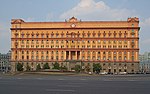
The Federal Security Service of the Russian Federation (FSB RF; Russian: Федеральная служба безопасности Российской Федерации (ФСБ РФ), tr. Federal'naya sluzhba bezopasnosti Rossiyskoy Federatsii, IPA: [fʲɪdʲɪˈralʲnəjə ˈsluʐbə bʲɪzɐˈpasnəstʲɪ rɐˈsʲijskəj fʲɪdʲɪˈratsɨɪ]) is the principal security agency of Russia and the main successor agency to the Soviet Union's KGB; its immediate predecessor was the Federal Counterintelligence Service (FSK) which was reorganized into the FSB in 1995. The three major structural successor components of the former KGB that remain administratively independent of the FSB are the Foreign Intelligence Service (SVR), the Federal Protective Service (FSO), and the Main Directorate of Special Programs of the President of the Russian Federation (GUSP). Its primary responsibilities are within the country and include counter-intelligence, internal and border security, counter-terrorism, and surveillance as well as investigating some other types of serious crimes and federal law violations. It is headquartered in Lubyanka Square, Moscow's center, in the main building of the former KGB. The director of the FSB is appointed by and directly answerable to the president of Russia.In 2003, the FSB's responsibilities were expanded by incorporating the Border Guard Service and a major part of the Federal Agency of Government Communication and Information (FAPSI); this would include intelligence activities in countries that were once members of the Soviet Union, work formerly done by the KGB's Fifth Service. The SVR had in 1992 signed an agreement not to spy on those countries; the FSB had made no such commitment.

NKVD

The People's Commissariat for Internal Affairs (Наро́дный комиссариа́т вну́тренних дел: Naródnyy komissariát vnútrennikh del; Russian pronunciation: [nɐˈrod.nɨj kə.mʲɪ.sə.rʲɪˈat ˈvnut.rʲɪ.nʲɪx̬ dʲel]), abbreviated NKVD (НКВД listen ), was the interior ministry of the Soviet Union. Established in 1917 as NKVD of the Russian Soviet Federative Socialist Republic, the agency was originally tasked with conducting regular police work and overseeing the country's prisons and labor camps. It was disbanded in 1930, with its functions being dispersed among other agencies, only to be reinstated as an all-union commissariat in 1934.The functions of the OGPU (the secret police organization) were transferred to the NKVD in 1934, giving it a monopoly over law enforcement activities that lasted until the end of World War II. During this period, the NKVD included both ordinary public order activities, as well as secret police activities. The NKVD is known for its role in political repression and for carrying out the Great Purge under Joseph Stalin. It was led by Genrikh Yagoda, Nikolai Yezhov and Lavrentiy Beria.The NKVD undertook mass extrajudicial executions of citizens, and conceived, populated and administered the Gulag system of forced labour camps. Their agents were responsible for the repression of the wealthier peasantry. They oversaw the protection of Soviet borders and espionage (which included political assassinations), and enforced Soviet policy in communist movements and puppet governments in other countries, most notably the repression and massacres in Poland.In March 1946 all People's Commissariats were renamed to Ministries, and the NKVD became the Ministry of Internal Affairs (MVD).