place

Sacred Heart College, Napier

1867 establishments in New ZealandCatholic secondary schools in New ZealandEducational institutions established in 1867Girls' schools in New ZealandSchools in Napier, New Zealand
Secondary schools in the Hawke's Bay RegionUse New Zealand English from July 2019

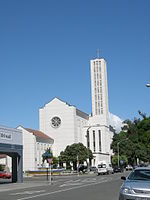
Sacred Heart College, Napier (Te Kareti o Ngakau Tapu) is a state-integrated Catholic girls' secondary school located in Napier, New Zealand. It was founded on its present site in 1867 by the Sisters of Our Lady of the Missions. For the first one hundred years of its existence, the College was staffed predominantly by the Sisters of the Missions. Sister Mary Rose who completed her term in 1998 was the last Mission Sister to hold the position of Principal. The original buildings withstood the 1931 Napier earthquake. Sacred Heart was a private school until 1982, when it along with all other Catholic schools in New Zealand integrated into the state education system. During the 1990s new buildings were erected and existing ones upgraded. The new Barbier and Marian blocks were blessed and opened, and Ross and Dennehy blocks were updated and rededicated. On 30 June 2001 the convent building, the chapel and a section of the hostel were destroyed by fire. These have now been, or are in the process of being, replaced. The latest addition is the full-sized gymnasium named after Sister Mary Rose Holderness. The boarding hostel attached to the college, which had accommodation for some seventy five girls, was closed in April 2010 Both the College and the hostel are administered on behalf of the Sisters by the Mission College Napier Trust Board and the Hostel Management Committee. The Board of Trustees administers government funds and governs the school.

Excerpt from the Wikipedia article Sacred Heart College, Napier (License: CC BY-SA 3.0, Authors).

Sacred Heart College, Napier
Convent Road, Napier Bluff Hill

Geographical coordinates (GPS) Address Phone number Website External links Nearby Places
placeShow on map

Wikipedia: Sacred Heart College, NapierContinue reading on Wikipedia

Geographical coordinates (GPS)

Latitude Longitude
N -39.4827 ° E 176.9115 °
placeShow on map

Address

Sacred Heart College

Convent Road
4110 Napier, Bluff Hill
Hawke's Bay, New Zealand
mapOpen on Google Maps

Phone number

call+6468353761

Website
sacredheartnapier.school.nz

linkVisit website

linkWikiData (Q15274244)
linkOpenStreetMap (145681409)

Share experience

Nearby Places

Napier, New Zealand
Napier, New Zealand

Napier ( NAY-pee-ər; Māori: Ahuriri) is a city on the eastern coast of the North Island of New Zealand and the seat of the Hawke's Bay region. It is a beachside city with a seaport, known for its sunny climate, esplanade lined with Norfolk Pines and extensive Art Deco architecture. Napier is sometimes referred to as the "Nice of the Pacific".The population of Napier is about 66,800 as of June 2022. About 18 km (11 mi) south of Napier is the inland city of Hastings. These two neighbouring cities are often called "The Bay Cities" or "The Twin Cities" of New Zealand, with the two cities and the surrounding towns of Havelock North and Clive having a combined population of 134,770. The City of Napier has a land area of 106 km2 (41 sq mi) and a population density of 540.0 per square kilometre. Napier is the nexus of the largest wool centre in the Southern Hemisphere, and it has the primary export seaport for northeastern New Zealand – which is the largest producer of apples, pears, and stone fruit in New Zealand. The Hawke's Bay wine region is now the second largest in New Zealand after Marlborough, and grapes grown around Hastings and Napier are sent through the Port of Napier for export. Large amounts of sheep's wool, frozen meat, wood pulp, and timber also pass through Napier annually for export. Smaller amounts of these materials are shipped via road and railway to the large metropolitan areas of New Zealand itself, such as Auckland, Wellington and Hamilton. Napier is a popular tourist city, with a unique concentration of 1930s Art Deco, and to a lesser extent Spanish Mission, architecture, built after much of the city was razed in the 1931 Hawke's Bay earthquake. It also has one of the most photographed tourist attractions in the country, a statue of the figure in local Ngāti Kahungunu mythology, Pania, on Marine Parade, Pania of the Reef. Thousands of people flock to Napier every February for the Tremains Art Deco Weekend event, a celebration of its Art Deco heritage and history. Other notable tourist events attracting many outsiders to the region annually include F.A.W.C! Food and Wine Classic events, and the Mission Estate Concert at Mission Estate Winery in the suburb of Taradale.

Napier Port
Napier Port

Napier Port is in Napier, New Zealand, on Hawke Bay. It is the North Island's second largest export port by tonnage, and is owned by Napier Port Holdings Limited (NZX: NPH). The port is connected to the rail network via the Napier Port Branch (Ahuriri Branch). It hosts dozens of cruise ship visits each year. On 16 February 2008 it was visited by the longest vessel it had received at the time, the MS Queen Victoria cruise ship belonging to Cunard. On December 15, 2014, the 138,194 tonne MS Voyager of the Seas visited the port, which was the joint 21st largest passenger ship at the time, and the largest to ever visit. On 5 January 2017, the port hosted the world's third largest cruise ship (at the time), the 168,666 tonne MS Ovation of the Seas.Hastings District, as one of the largest apple, pear and stone fruit producing areas in New Zealand has an important relationship with the Napier Port. It has also become an important grape growing and wine production area with the fruit passing from the growers around Metropolitan Hastings and then to Napier for exporting. Napier is an important service centre for the agriculture and pastoral output of the predominantly rural Hastings District. The port handled 157,700 containers (roughly 9% of all containers handled by New Zealand ports) in the 2015 calendar year, behind the ports of Auckland, Tauranga and Lyttelton.A public poll was held in January 1885 on the decision to move the port from the Ahuriri spit to its current location, beneath Bluff Hill. The breakwater harbor was completed in 1886, and the container depot was established in 1994. A new wharf is currently being planned (as of early 2016) to handle projected volume growth and larger vessels, and will be the port's largest ever single investment, at $50 million NZD. This will help to maintain the port's position as the fourth-largest container terminal in the country, processing more containers than Wellington, Nelson and New Plymouth combined.