place

If Day

1942 in Canada1942 in military historyCanada in World War IIHistory of WinnipegWorld War II propaganda
Fake Nazi soldiers assaulting a Winnipeg Free Press newsie, 19 February 1942

If Day (French: "Si un jour", "If one day") was a simulated Nazi German invasion and occupation of the Canadian city of Winnipeg, Manitoba, and surrounding areas on 19 February 1942, during the Second World War. It was organized as a war bond promotion by the Greater Winnipeg Victory Loan organization, which was led by prominent Winnipeg businessman J. D. Perrin. The event was the largest military exercise in Winnipeg to that point.If Day included a staged firefight between Canadian troops and volunteers dressed as German soldiers, the internment of prominent politicians, the imposition of Nazi rule, and a parade. The event was a fundraiser for the war effort: over $3 million was collected in Winnipeg on that day. Organizers believed that the fear induced by the event would help increase fundraising objectives. It was the subject of a 2006 documentary, and was included in Guy Maddin's film My Winnipeg.

Excerpt from the Wikipedia article If Day (License: CC BY-SA 3.0, Authors, Images).

If Day
Portage and Main Circus, Winnipeg Downtown

Geographical coordinates (GPS) Address Nearby Places
placeShow on map

Wikipedia: If DayContinue reading on Wikipedia

Geographical coordinates (GPS)

Latitude Longitude
N 49.895555555556 ° E -97.138611111111 °
placeShow on map

Address

Portage and Main

Portage and Main Circus
R3X 1V3 Winnipeg, Downtown
Manitoba, Canada
mapOpen on Google Maps

Fake Nazi soldiers assaulting a Winnipeg Free Press newsie, 19 February 1942
Share experience

Nearby Places

Downtown Winnipeg
Downtown Winnipeg

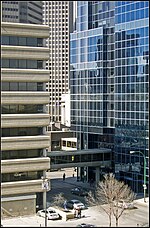
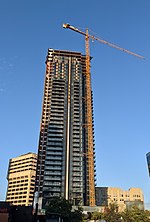
Downtown Winnipeg is an area of Winnipeg located near the confluence of the Red and Assiniboine rivers. It is the oldest urban area in Winnipeg, and is home to the city's commercial core, city hall, the seat of Manitoba's provincial government, and a number of major attractions and institutions. The City of Winnipeg's official downtown boundaries are: the Canadian Pacific Railway mainline on the north, Gomez Street and the Red River on the east, and the Assiniboine River on the south; the western boundaries of downtown are irregular, following along a number of different streets, back lanes, and across properties. Generally speaking, the western boundaries are rarely further west of Balmoral and Isabel Streets. In 2016, Canadian Geographic produced a map that generalize Winnipeg's downtown boundaries.Neighbourhoods in the downtown area include the Exchange District, Central Park, The Forks, and Chinatown. The downtown area is roughly 3 square kilometres (740 acres). Winnipeg Square, Canada Life Centre, Portage Place, and the flagship store of The Bay (closed 30 November 2020) are all located on the downtown section of Portage Avenue. On Main Street are Winnipeg's City Hall, Union Station, and the Manitoba Centennial Centre, which includes the Manitoba Museum, the Planetarium, the Centennial Concert Hall, and the Winnipeg Railway Museum. Although over 60,000 people work downtown, only 13,470 people actually live in the Downtown area.There are several residential projects under construction on Waterfront Drive and in the Exchange District, and the residential population of the area is projected to increase substantially in the next few years.