place

Institute for Biodiagnostics

1992 establishments in ManitobaBuildings and structures in downtown WinnipegLaboratories in CanadaNational Research Council (Canada)Research institutes in Manitoba

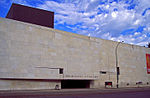
The National Research Council Institute for Biodiagnostics (NRC-IBD) is a research laboratory located in Winnipeg, Manitoba, Canada, and operated by the National Research Council. It was established in 1992 to research and developnoninvasive medical diagnostic technologies to increase prospects for prevention, earlier diagnosis, improved treatment and prognosis of diseases.Located adjacent to the University of Winnipeg campus in downtown Winnipeg, NRC-IBD also has satellite institutes in Halifax and Calgary.NRC-IBD conducts its research in partnership with medical schools, universities, other research organizations, and industry. Its research projects fall into the following six programs: Cancer research; cardiovascular disease research; IT-based decision technology; medical photonics; MR research and technology development; and neuroscience research.Its impact on Winnipeg's economy amounts to $30 million a year.

Excerpt from the Wikipedia article Institute for Biodiagnostics (License: CC BY-SA 3.0, Authors).

Institute for Biodiagnostics
Ellice Avenue, Winnipeg Daniel McIntyre

Geographical coordinates (GPS) Address Nearby Places
placeShow on map

Wikipedia: Institute for BiodiagnosticsContinue reading on Wikipedia

Geographical coordinates (GPS)

Latitude Longitude
N 49.8939 ° E -97.1506 °
placeShow on map

Address

Ellice Avenue

Ellice Avenue
R3B 2M6 Winnipeg, Daniel McIntyre
Manitoba, Canada
mapOpen on Google Maps

Share experience

Nearby Places

Winnipeg Art Gallery

The Winnipeg Art Gallery (WAG) is an art museum in Winnipeg, Manitoba, Canada. Its permanent collection includes over 24,000 works from Canadian, Indigenous Canadian, and international artists. The museum also holds the world's largest collection of Inuit art. In addition to exhibits for its collection, the museum has organized and hosted a number of travelling arts exhibitions. Its building complex consists of a main building that includes 11,000 square metres (120,000 sq ft) of indoor space and the adjacent 3,700-square-metre (40,000 sq ft) Qaumajuq building. The present institution was formally incorporated in 1963, although it traces its origins to the Winnipeg Museum of Fine Arts, an art museum opened to the public in 1912 by the Winnipeg Development and Industrial Bureau. The bureau opened the Winnipeg School of Arts in the following year, and operated the art museum and art school until 1923, when the two entities were incorporated as the Winnipeg Gallery and School of Arts. In 1926, the Winnipeg Art Gallery Association was formed to assist the institution in operating its museum component. The Winnipeg Gallery and School of Art was dissolved in 1950, although its collection was loaned indefinitely to the Winnipeg Art Gallery Association, who continued to exhibit it. In 1963, the Winnipeg Art Gallery Association was formally incorporated as the Winnipeg Art Gallery by the Legislative Assembly of Manitoba. The museum moved to its present location in September 1971, with the opening of a purpose-built building designed by Gustavo da Roza. In 2021, the museum opened a Michael Maltzan-designed Qaumajuq building in order to house the museum's Inuit art collection.

Manitoba Hydro Place

Manitoba Hydro Place (MHP) is an office tower serving as the headquarters building of Manitoba Hydro, the electric power and natural gas utility in the province of Manitoba, Canada. Located at 360 Portage Avenue in downtown Winnipeg and connected to the Winnipeg Walkway system, Manitoba Hydro Place received LEED Platinum certification in May 2012, making it the most energy-efficient office tower in North America and the only office tower in Canada to receive the LEED Platinum rating.Opened as Winnipeg's 4th tallest building in September 2009, the 21-story office tower brought together 1,650 employees from 15 suburban locations into one 695,000 sq ft (64,568 m2) high-rise on a full, downtown block. With the design's plan view resembling a capital letter "A", the project comprises two 18-storey twin wings framing three 6-storey, south-facing atria (winter gardens). The design's stepped, three-storey, street-scaled podium contains retail space as well as an interior pedestrian street and a single level of parking, partially below grade — over which sit the atria, office wings and their 3-storey mechanical penthouse. Total project cost was C$278m.The building's bioclimatic, energy-efficient design features a 377 ft (115 m) tall solar chimney, a geo-thermal HVAC system using 280 five-inch tubes bored 380 feet into an underground aquifer, 100% fresh air (24 hours a day, year-round, regardless of outside temperature) and a one-meter-wide double exterior wall with computer-controlled motorized vents that adjust the building's exterior skin throughout the day and evening. Together, the various elements of the design enable a 70% energy savings over a typical large office tower.In 2009, CBC News called Manitoba Hydro Place one of "the most energy-efficient office towers in the world" and the Toronto Star called MHP the "most important building in Canada."