place

Ahsan Manzil

British colonial architecture in BangladeshBuildings and structures in DhakaDhaka Nawab familyHistory museums in BangladeshIndo-Saracenic Revival architecture
Museums in DhakaNational symbols of BangladeshOld DhakaPalaces in BangladeshTourist attractions in DhakaUse Bangladeshi English from January 2022
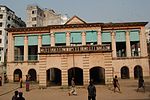
Ahsan Manzil Front View

Ahsan Manzil is the erstwhile official residential palace and seat of the Nawab of Dhaka. The building is situated at Kumartoli along the banks of the Buriganga River in Dhaka, Bangladesh. Construction was started in 1859 and was completed in 1872. It was constructed in the Indo-Saracenic Revival architecture. It has been designated as a national museum.

Excerpt from the Wikipedia article Ahsan Manzil (License: CC BY-SA 3.0, Authors, Images).

Ahsan Manzil
Ahsanullah Road, Dhaka Bangla Bazar

Geographical coordinates (GPS) Address External links Nearby Places
placeShow on map

Wikipedia: Ahsan ManzilContinue reading on Wikipedia

Geographical coordinates (GPS)

Latitude Longitude
N 23.708597222222 ° E 90.406058333333 °
placeShow on map

Address

Ahsan Manzil

Ahsanullah Road
1100 Dhaka, Bangla Bazar
Dhaka Division, Bangladesh
mapOpen on Google Maps

linkWikiData (Q402937)
linkOpenStreetMap (8665455)

Ahsan Manzil Front View
Share experience

Nearby Places

Old Dhaka
Old Dhaka

Old Dhaka (Bengali: পুরান ঢাকা, romanized: Puran Dhaka) is a term used to refer to the historic old city of Dhaka, the capital of Bangladesh. It was founded in 1608 as Jahangirabad or Jahangirnagar (Bengali: জাহাঙ্গীরনগর, romanized: Jahangirnogor, lit. 'City of Jahangir'), the capital of Mughal Province of Bengal and named after the Mughal emperor Jahangir. It is located on the banks of the Buriganga River. It was one of the largest and most prosperous cities of South Asia and the center of the worldwide muslin trade. The then Nawab of Bengal Murshid Quli Khan shifted the capital from Dhaka to Murshidabad in the early-18th century. With the rise of Calcutta (now Kolkata) during the British rule, Dhaka began to decline and came to be known as the "City of Magnificent Ruins". The British however began to develop the modern city from the mid-19th century. Old Dhaka is famous for its variety of foods and amicable living of people of all religions in harmony. The main Muslim festivals celebrated with funfair here are Eid-ul-Fitr, Eid-ul-Adha and Ashura, Hindu festivals like Durga Puja, Kali Puja, and Saraswati Puja are also celebrated with enthusiasm. The festivals which are celebrated by all religious communities with much splendor include Shakrain (পৌষ সংক্রান্তি), Pohela Falgun, and Halkhata (হালখাতা). Religion-wise, the old Dhaka is predominantly Muslim, while a significant number of Hindus also reside here. Christians and Buddhists are also inhabitants here in small numbers. Its inhabitants are known as Dhakaiya and converse in the Dhakaiya Kutti and Dhakaiya Urdu languages.