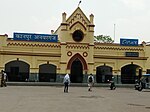
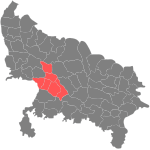
Kanpur or Cawnpore (/kɑːnˈpʊər/ pronunciation (help·info)) is an industrial city in the central-western part of the state of Uttar Pradesh, India. Founded in 1207, Kanpur became one of the most important commercial and military stations of British India. Kanpur was also the financial capital of Uttar Pradesh. Nestled on the banks of Ganges River, Kanpur stands as the major financial and industrial centre of North India and also the ninth-largest urban economy in India. Today it is famous for its colonial architecture, gardens, parks and fine quality leather, plastic and textile products which are exported mainly to the West.It is known for its rich cultural heritage, bustling markets, vibrant nightlife, beautiful parks and gardens, delicious cuisine and much more. The city is home to historical monuments such as the Jajmau Ghat which dates back to 17th century AD.
Kanpur is also home to several historical sites such as the Bithoor Museum, the Shri Krishna Janmabhoomi Temple and Nanarao Park.
Kanpur also hosts various events throughout year including Kumbh Mela, the world's largest religious gathering, held every 12 years on the banks of the River Ganges.
It is the 12th most populous city and the 11th most populous urban agglomeration in India. Kanpur was an important British garrison town until 1947, when India gained independence. The urban district of Kanpur Nagar serves as the headquarters of the Kanpur Division, Kanpur Range and Kanpur Zone.
With the first woollen mill of India, commonly known as the Lal Imli (literally meaning "Red Tamarind", for a brand produced by the mill) by the British India Corporation established here in 1876 by Alexander MacRobert. The eastern and northern façades of the mill are reminiscent of the Palace of Westminster, due to their architecture, proximity to the Ganges river and with the north-east corner of the mill being topped by a clock tower similar to Big Ben in London. This similarity underscores the city's importance and prestige during the British times, which extends till date; making the Lal Imli — a great highlight of the city. The city is also widely regarded as the "Leather City of the World" and is predominantly nicknamed as the "Manchester of the East", for its chemical, textile and leather industries.
According to 2011 Indian census, it is the eleventh most populous urban city and the largest urban agglomeration in Uttar Pradesh while the population of city and its suburb were around 5 million making it the eighth-most populous metropolitan area in India. Furthermore, it is considered the world's most polluted city by particulate matter concentration. In 2018, Kanpur was considered by the World Health Organization as the city with the world's worst air pollution.
 Continue reading on Wikipedia