place

St. Lazarus' Church, Macau

1560 establishments in China1560 establishments in the Portuguese Empire16th-century Roman Catholic church buildings in China16th-century establishments in MacauAsian building and structure stubs
Asian church stubsMacau stubsPortuguese colonial architecture in ChinaReligious organizations established in the 1550sRoman Catholic churches completed in 1560Roman Catholic churches in Macau
Igreja de Sao Lazaro

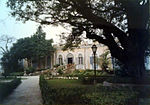
St. Lazarus' Church (Chinese: 望德聖母堂; Portuguese: Igreja de São Lázaro) is a historic church in São Lázaro, Macau, China. Built between 1557 and 1560, it is one of the oldest churches in Macau and located on Rua de João de Almeida.It currently serves as the main church of the St. Lazarus parish. The church was completely rebuilt in 1885, although the Cross of Hope from the original chapel is located in the forecourt of the current structure.

Excerpt from the Wikipedia article St. Lazarus' Church, Macau (License: CC BY-SA 3.0, Authors, Images).

St. Lazarus' Church, Macau
聖母堂前地 Adro de S. Lázaro,

Geographical coordinates (GPS) Address Nearby Places
placeShow on map

Wikipedia: St. Lazarus' Church, MacauContinue reading on Wikipedia

Geographical coordinates (GPS)

Latitude Longitude
N 22.197222222222 ° E 113.54527777778 °
placeShow on map

Address

望德聖母堂

聖母堂前地 Adro de S. Lázaro 8
519020 , 塔石 Tap Siac
Macau, China
mapOpen on Google Maps

Igreja de Sao Lazaro
Share experience

Nearby Places

Fortaleza do Monte
Fortaleza do Monte

The Fortaleza do Monte (Portuguese for Mount Fortress, also Monte Forte; officially Fortaleza de Nossa Senhora do Monte de São Paulo, in English: Fortress of Our Lady of the Mount of St. Paul; Chinese: 大砲台; Cantonese Yale: daaih paau yìh) is a fort in Santo António in Macau. It is the historical military centre of Macau. The fort forms part of the "Historic Centre of Macau" and is a UNESCO World Heritage Site.The fort was built between 1617 and 1626 on the 52-metre tall Mount Hill, located directly east of the Ruins of Saint Paul's. It was constructed to protect the properties of the Jesuits (mainly Portuguese Jesuits) in Macau, especially from pirates. Later, the fort was taken over by the Portuguese colonial governor and the relevant authorities for the defence of Macau. The fort occupies an area of roughly 8,000 square metres. Thirty-two muzzle-loading cannon were placed around the fort's walls, and the two corners of the southeastern fort wall have small watchtowers. The fort proved crucial in successfully holding off the attempted Dutch invasion of Macau in 1622.The fort remained a restricted military area until 1965 when the barracks in the fort were converted into a weather observatory and the fort was opened to the public. The observatory ceased its function and was relocated to Taipa in 1996 before it was demolished to make way for the Museum of Macau, which was officially opened on 19 April 1998. The tree-covered park at the top of the fort has a panoramic view of the mainland area of Macau. Apart from being a fortress, it has served various functions: The first residence of the governors of Macau (in 1623 and in 1740). The base for two companies of the Portuguese Prince Regent Battalion to act as a police force from 1810 to 1841. A weather observatory of the Meteorological Department of Portuguese Macau (from 1966 to 1996). The Museum of Macau (1998 to present).