place

William Scarbrough House

Historic American Buildings Survey in Georgia (U.S. state)Houses completed in 1819Houses in Savannah, GeorgiaMarine art museums in the United StatesMaritime museums in Georgia (U.S. state)
Museums in Savannah, GeorgiaNational Historic Landmarks in Savannah, GeorgiaNational Register of Historic Places in Savannah, GeorgiaSavannah Historic DistrictUse mdy dates from May 2021
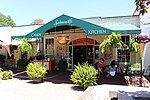
William Scarbourgh house, Savannah, GA, US

William Scarbrough House is a historic house in Savannah, Georgia. Built in 1819, and subjected to a number later alterations, it is nationally significant as an early example of Greek Revival architecture, and is one of the few surviving American works of architect William Jay. The house was declared a National Historic Landmark in 1973. It is now home to the Ships of the Sea Maritime Museum, and it has largely been restored to an early 19th-century appearance. The house was built for William Scarbrough, one of the principal owners of the SS Savannah, which in 1819 became the first steamship in the world to cross the Atlantic Ocean.

Excerpt from the Wikipedia article William Scarbrough House (License: CC BY-SA 3.0, Authors, Images).

William Scarbrough House
Martin Luther King Junior Boulevard, Savannah Savannah Historic District

Geographical coordinates (GPS) Address Website Nearby Places
placeShow on map

Wikipedia: William Scarbrough HouseContinue reading on Wikipedia

Geographical coordinates (GPS)

Latitude Longitude
N 32.08117 ° E -81.09727 °
placeShow on map

Address

Ships of the Sea Mairitme Museum (William Scarboroug House and Gardens)

Martin Luther King Junior Boulevard
31412 Savannah, Savannah Historic District
Georgia, United States
mapOpen on Google Maps

Website
shipsofthesea.org

linkVisit website

William Scarbourgh house, Savannah, GA, US
Share experience

Nearby Places

Franklin Square (Savannah, Georgia)

Franklin Square is one of the 22 squares of Savannah, Georgia, United States. It is located in the northernmost row of the city's five rows of squares, at Montgomery Street and West St. Julian Street. It is west of Ellis Square in the northwestern corner of the city's grid of squares. The square now anchors the western end of the City Market retail area.The oldest building on the square is 317 West Bryan Street, the Abram Minis Building, which dates to 1846.The square is named for Benjamin Franklin, one of the Founding Fathers of the United States. It once contained a forty-foot-tall water tower to distribute water to residents. It was built with after the previous system of public and private surface wells was overwhelmed by the rising population of the city. The water was taken out of the Savannah River west of the Ogelthorpe Canal Basin before being filtered and pumped up to the water tower. Because of the tower, Franklin Square was also known as Water Tank Square, Water Tower Square and Reservoir Square.The square was destroyed in 1935 with the routing of U.S. Highway 17 on Montgomery Street but was restored in the mid-1980s. In 1967, Montgomery Street was changed from two-way to one-way between Jones and Bay streets; in 1985, however, to assist with the restoration of Franklin Square, it was restored to two-way traffic between Bay and Broughton streets. In 2019, the bi-directional traffic flow was extended from Broughton to Liberty streets.

City Market (Savannah, Georgia)

City Market is a historic market complex in the Historic District of Savannah, Georgia. Originally centered on the site of today's Ellis Square from 1733, today it stretches west from Ellis Square to Franklin Square. Established in the 1700s with a wooden building, locals gathered here for their groceries and services. This building burned in 1820 and was replaced the following year with a single-storey structure that wrapped around the square. A brick building, the work of architects Augustus Schwaab and Martin Phillip Muller, was erected in 1876. They had submitted plans to the city six years earlier. The cost of the building's construction "vastly exceeded expectations" after excavations revealed weakened arches in the basement floor that required them to be replaced. It was an ornate structure with arches in the Romanesque style and large circular windows.The interior of the Schwaab and Muller structure encompassed 33,000 square feet. The city's mayor, John Screven, described it as "roomy, capable of being kept in the highest condition of cleanliness, with ample ventilation". The construction was headed by carpenter James C. Saltus.The market area survived two fires (in 1796 and 1820), the Civil War, and the hurricane of 1896. It is now part of the Savannah Historic District, and is a popular destination for tourists due to its restaurants, art galleries and shops, which occupy many of the buildings erected in the 19th century.