place

Ribeira Brava, Madeira

Madeira IslandMunicipalities of MadeiraPages including recorded pronunciationsPages with Portuguese IPAPeople from Ribeira Brava, Madeira
Towns in Portugal
Ribeira Brava 508
Ribeira Brava 508

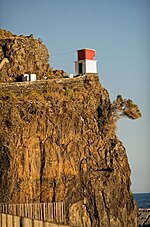
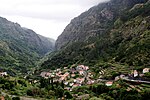
Ribeira Brava (Portuguese pronunciation: [ʁiˈβɐjɾɐ ˈβɾavɐ] ; lit. 'Angry River') is a municipality on the island of Madeira, in the Portuguese Autonomous Region of Madeira. It is located along the southern coast (approximately centre), and is west of Câmara de Lobos and the regional capital Funchal, south of São Vicente, and east of Ponta do Sol. The population in 2011 was 13,375, in an area of 65.41 km2.The municipality gained its name due to its river, which translates as "angry river". In rainy seasons, the river had an extremely strong and powerful current, that often wreaked havoc over the entire eight kilometres of the route.

Excerpt from the Wikipedia article Ribeira Brava, Madeira (License: CC BY-SA 3.0, Authors, Images).

Ribeira Brava, Madeira
Ribeira Brava,

Geographical coordinates (GPS) Address Nearby Places
placeShow on map

Wikipedia: Ribeira Brava, MadeiraContinue reading on Wikipedia

Geographical coordinates (GPS)

Latitude Longitude
N 32.683333333333 ° E -17.05 °
placeShow on map

Address

Ribeira Brava (Via Rápida 1)

Ribeira Brava
9350-246 (Ribeira Brava)
Portugal
mapOpen on Google Maps

Ribeira Brava 508
Ribeira Brava 508
Share experience

Nearby Places

Paul da Serra
Paul da Serra

Paul da Serra in the municipal county of Ponta do Sol, Madeira, is the largest and most extensive plateau of Madeira, at about 24 km2 (9.3 sq mi), with an altitude averaging about 1,500 m (4,900 ft). Its highest point is the peak pico do Paul at 1,640 m (5,380 ft) from where the length of the entire plateau can be viewed. On days with good visibility, both the south and north coasts are visible.Paul da Serra is considered the most important area of the islands groundwater recharge, and their planar structure facilitates the infiltration of a significant part of high rainfall year, while slowing the runoff towards the sea. The ground cover in almost all the Paul da Serra is composed of underbrush, reminiscent of its former use as grazing site, stressing among other the Feiteira (Pteridium aquilinum), highland bent, (Agrostis castellana), broom (Cytisus scoparius ssp. scoparius, C. striatus and C. multiflorus), the gorse (Ulex europaeus ssp. latebracteatus and U. minor), St. John's wort (Hypericum perforatum) or pelicão (Hypericum linarifolium and H. humifusum) and Thymus micans, an endemic species of Madeira, confined to the central mountain massif. With the abandonment of grazing due to government policies for environmental recovery, the island's mountains can be seen recovering, slowly but consistently, vegetation thought to be the original, before slaughter by the colonizers. This vegetation, mainly composed of heather species Erica arborea and Erica platycodon ssp. maderincola, heathland form of altitude sized tree up to 9 m (30 ft) high, as observed in the area of Bica da Cana, in the northeast of the plateau. However, the cedar-of-Madeira (Juniperus cedrus ssp. maderensis) that should have been part of that original vegetation, hardly will again take its place.As a flat area, it is favorable to the installation of wind farms. Virtually all wind energy produced on the island comes from these.