place

Maihaugen

Buildings and structures in LillehammerMuseums in InnlandetOpen-air museums in NorwayPhotography archives in NorwayVenues of the 1994 Winter Olympics
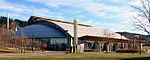
Maihaugen entrance
Maihaugen entrance

Maihaugen (De Sandvigske Samlinger på Maihaugen, Lillehammer) is one of the most visited tourist attractions in Lillehammer, Norway. Maihaugen, with close to 200 buildings, is one of Northern Europe's largest open-air museums and is one of the largest cultural facilities in Norway.

Excerpt from the Wikipedia article Maihaugen (License: CC BY-SA 3.0, Authors, Images).

Maihaugen
The square, Lillehammer

Geographical coordinates (GPS) Address Nearby Places
placeShow on map

Wikipedia: MaihaugenContinue reading on Wikipedia

Geographical coordinates (GPS)

Latitude Longitude
N 61.112822222222 ° E 10.478433333333 °
placeShow on map

Address

Bakeriet

The square
2609 Lillehammer
Norway
mapOpen on Google Maps

Maihaugen entrance
Maihaugen entrance
Share experience

Nearby Places

Stampesletta
Stampesletta

Stampesletta is a multi-use stadium complex in Lillehammer, Norway. Owned and operated by Lillehammer Municipality, it consists of a track and field venue, an artificial turf football field, three natural grass football fields, a gravel field and natural grass training pitches. In addition, it features a club house, locker facilities and a grandstand between the athletics and artificial turf fields. The venue is located about 1 kilometer (0.6 mi) from the town center, and serves as the home ground for the Second Division side Lillehammer FK, Lillehammer KFK, Roterud IL in football, and Lillehammer IF in athletics. Construction of Stampesletta started in 1946 and the grass football field opened in 1949. A now removed equestrian exhibition area opened in 1958, and in 1973 the track and field venue opened. The latter received a hard surface in 1982. During the 1994 Winter Olympics, Stampesletta itself was used for medal ceremonies, attracting crowds of up to 30,000 people. The area around Stampesletta was sometimes referred to as the Olympic Park, as it also has in its immediate vicinity the ice hockey venues Håkons Hall and Eidsiva Arena, the ski jumping hill Lysgårdsbakken, and Kanthaugen Freestyle Arena. The two halls are often regarded as part of Stampesletta. The arena is used as the goal are for Birkebeinerrittet and Birkebeinerløpet, and from 1932 to 1992 for Birkebeinerrennet. Stampesletta hosted the Norwegian Athletics Championships in 1977, 1995 and 2009, and annually hosts Norway's second-largest track and field tournament, Veidekkelekene. Stampesletta is scheduled to host the opening and closing ceremonies of the 2016 Winter Youth Olympics.

Lillehammer Olympiapark

Lillehammer Olympiapark AS, trading as Olympiaparken, is a company established following the 1994 Winter Olympics to operate the Olympic venues in Lillehammer, Norway. Owned by Lillehammer Municipality, it operates five sports venues: Birkebeineren Ski Stadium, Håkons Hall, Lillehammer Olympic Bobsleigh and Luge Track, Kanthaugen Freestyle Arena and the ski jumping hill of Lysgårdsbakken. In addition to serving sports events, the company provides tourist and group activities at the venues as well as catering to larger events. In the Lillehammer bid for the 1994 Winter Olympics, the agreement between Lillehammer Municipality and the state specified that the municipality was responsible for financing all necessary sports venues. However, after the games were awarded the responsibility was taken over by Lillehammer Olympic Organizing Committee (LOOC) and the town's five venues were ultimately funded through state grants. To allow for post-Olympic use, a fund was created by the state, of which Lillehammer Olympiapark received 146 million Norwegian krone (NOK). Unlike the Hamar venues, which survive on their fund's yield, the Lillehammer venues have used up their capital. From 2014 the post-Olympic use fund will be depleted and alternative organization and funding is being looked into. A leading proposal is that the bobsleigh and luge track be taken over by the state, while the remaining venues be retained by the company and jointly funded by the municipality and Oppland County Municipality.