place

Kose, Tallinn

Subdistricts of TallinnTallinn geography stubs
Tallinn kose asum
Tallinn kose asum

Kose (Estonian for "Falls") is a subdistrict of the district of Pirita in Tallinn, the capital of Estonia. It has a population of 3,351 (As of 1 January 2014).

Excerpt from the Wikipedia article Kose, Tallinn (License: CC BY-SA 3.0, Authors, Images).

Kose, Tallinn
Puhkekodu tee, Tallinn Pirita linnaosa

Geographical coordinates (GPS) Address Nearby Places
placeShow on map

Wikipedia: Kose, TallinnContinue reading on Wikipedia

Geographical coordinates (GPS)

Latitude Longitude
N 59.459209 ° E 24.873176 °
placeShow on map

Address

Puhkekodu tee 42
12014 Tallinn, Pirita linnaosa
Estonia
mapOpen on Google Maps

Tallinn kose asum
Tallinn kose asum
Share experience

Nearby Places

Metsakalmistu
Metsakalmistu

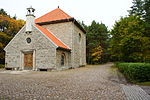
Metsakalmistu (meaning Forest Cemetery) is a cemetery in the Pirita district of Tallinn. Metsakalmistu was originally planned to be a public medieval cemetery. Eduard Vilde was the first to be buried in 1933. The original area of the cemetery was 24.2 hectares, but has since expanded to be 48.3 hectares. Metsakalmistu was officially opened in 1939. That same year, 15 people were buried in the cemetery. In 1939, the nearby Kloostrimetsa Farm cemetery was created, which eventually, through expansion, became part of an expanded Metsakalmistu. At first, the designers of the cemetery were unanimous about the general design requirements of the cemetery, but the area was still dominated by the appearance of a wild forest. Initially, there was placement of crosses, girders, ranks, and calcareous stones, the largest size of which were 80x50 cm. Subsequently, the use of natural barriers, such as grass slabs, were built and have been extended to include a moss bed cover, along with borders marked by flowers. Monumental gravestones were not recommended initially for the cemetery, but they still exist to a small extent. At present, the permissible maximum height for a pillar is 1.5 m. The main chapel of Metsakalmistu was built in 1936, with its main architect being Herbert Johanson. The chapel was vandalized by the Soviet Union after the establishment of the Estonian SSR, but in 1996 it was restored with the support of the Tallinn City Government. In 2006, a columbarium was built. Tombstones in Metsakalmistu are reserved for notable Estonian people involved in, among other professions, theatre, sports, composing, writing, the arts, journalism, medicine, architecture, and science, as well as other public figures; those who were soldiers in the Finnish Infantry Regiment 200, as well as the veterans of the Estonian War of Independence, are also buried here.

Tallinn TV Tower
Tallinn TV Tower

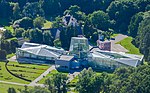
Tallinn TV tower (Estonian: Tallinna teletorn) is a free-standing structure with an observation deck, built to provide better telecommunication services for the 1980 Moscow Summer Olympics regatta event (see Sailing at the 1980 Summer Olympics). It is located near the suburb Pirita, six km north-east of the Tallinn city center. With its 313 m (1030.2 ft), the TV tower is the tallest nonbuilding structure in Tallinn. The tower was officially opened on 11 July 1980. The viewing platform at a height of 170 metres was open to the public until 26 November 2007, when it was closed for renovation. The tower began receiving visitors again on 5 April 2012. The building is administered by the public company Levira (formerly Estonian Broadcasting Transmission Center Ltd) and is a member of the World Federation of Great Towers.The architects were David Baziladze and Juri Sinis, the engineers Vladimir Obydov and Yevgeny Ignatov. The construction work was supervised by Aleksander Ehala. The cornerstone was laid on 30 September 1975, and the building was inaugurated 11 July 1980 (although the first transmission took place in 1979). The tower body was constructed of reinforced concrete rings 50 cm thick that weigh a total of 17,000 tonnes, and the total tower weight is approximately 20,000 tonnes. The tower survived a fire during construction. The observation deck on the 21st floor, originally designed to have a rotating section, is located 170 m above ground and has a diameter of 38 m. The tower was closed to the public on 26 November 2007. Before it was closed, tickets were priced at 60 Estonian kroon and, aside from an infrequently used concrete and metal staircase, the observation deck was accessed by two elevators. The Vilnius TV tower has a similar architectural design but features a rotating observation deck 165 m above ground. The structure consists of a 190-metre reinforced concrete tower and a 124-metre metal mast on top of it. Under the tower is a two-storey building with equipment rooms, entrance halls and a conference centre. The diameter of the tower at its base is 15.2 metres and the wall thickness is 50 cm. The diameter of the tower from 140 metres up is 8.2 metres. A total of 10,000 m3 of concrete and 1,900 tonnes of steel were used in the construction. The Tallinn TV tower was reopened on 5 April 2012 with completely new interior design made by KOKO Arhitektid. Local guide books advertise the observation deck's views of Tallinn and extending to the Gulf of Finland. The tower is described as having a 1980s Soviet feel and a restaurant is located on the observation floor. Bullet holes dating from the Soviet coup attempt of 1991 are still visible at the base of the tower.