place

EML Kalev (M414)

1966 shipsCold War minesweepers of GermanyEstonian Mineships DivisionFrauenlob-class minesweepersFrauenlob-class minesweepers of the Estonian Navy
Museum ships in EstoniaShips built in Rendsburg
EML Kalev (M414), ship

EML Kalev (M414) was a Frauenlob-class minesweeper of the Estonian Navy, which belonged to the Mineships Division.

Excerpt from the Wikipedia article EML Kalev (M414) (License: CC BY-SA 3.0, Authors, Images).

EML Kalev (M414)
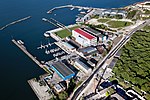
Lennusadama, Tallinn Põhja-Tallinna linnaosa

Geographical coordinates (GPS) Address Nearby Places
placeShow on map

Wikipedia: EML Kalev (M414)Continue reading on Wikipedia

Geographical coordinates (GPS)

Latitude Longitude
N 59.452806 ° E 24.735455 °
placeShow on map

Address

Kalev (M414)

Lennusadama
10413 Tallinn, Põhja-Tallinna linnaosa
Estonia
mapOpen on Google Maps

EML Kalev (M414), ship
Share experience

Nearby Places

USCGC Bittersweet (WLB-389)

USCGC Bittersweet (WLB 389) was a C or Iris-class 180-foot buoy tender of the United States Coast Guard. Built by the Zenith Dredge Company of Duluth, Minnesota, the ship was laid down on 16 September 1943, and launched on 11 November 1943. Commissioned on 11 May 1944, Bittersweet was assigned to the 17th Coast Guard District, and sailed for Alaska via the St. Lawrence River, the Panama Canal and San Francisco, arriving on 19 November 1944. Based at Kodiak, her primary mission was the performance of general aids to navigation (ATON) duties, but she also carried out numerous search and rescue operations, fought fires, delivered medical supplies, and enforced fishing laws. At the end of the war in September 1945, in addition continuing her ATON duties, Bittersweet was now charged with the performance of law enforcement duties. Kodiak remained the ship's homeport until 30 June 1964 when it changed to Ketchikan. She remained there until mid-1976 when the ship underwent major renovations at the Coast Guard Yard at Curtis Bay, Maryland. Bittersweet was then stationed at Woods Hole, Massachusetts and used for ATON and icebreaking. In addition she took part in oil spill cleanup operations and also participated in the International Ice Patrol, collecting hydrographic and drift buoy data off the Grand Banks using a mobile laboratory. Bittersweet was decommissioned on 18 August 1997, and given to Estonia. Renamed Valvas, the ship served in the Estonian Border Guard until it was decommissioned in July 2014 and given to the Estonian Maritime Museum. It is to become a museum ship.

Seaplane Harbour
Seaplane Harbour

The Seaplane Harbour (Estonian: Lennusadam) is a maritime museum in Tallinn, Estonia, opened in spring 2012. The museum is part of the Estonian Maritime Museum.The museum is located in the Tallinn aeroplane harbour in a building originally constructed as a hangar for seaplanes in the area of Peter the Great's Naval Fortress. The hall has an area of 8000 m2. The hall was put out of service during the Soviet era. Its renovation started in 2010. The renovation was funded 70% by the European Regional Development Fund and 30% by the Estonian state. The main attraction in the museum is the 1936 submarine Lembit, which was ordered by Estonia from the United Kingdom, and has nowadays been renovated to its original 1930s appearance. The museum also has a yellow submarine, which can be used to familiarise oneself with piloting a submarine, and a full-scale replica of a World War I era Short Type 184 seaplane. None of the original seaplanes remain to this day. The wreck of the wooden ship Maasilinn dates to the 16th century and had sailed between Saaremaa and mainland Estonia. The icebreaker Suur Tõll originally sailed for Finland under the name Wäinämöinen. It was conquered from the Russians near Helsinki in 1918 and donated to Estonia from Finland in 1922 according to the Treaty of Tartu.There is also a special exhibit illustrating the background to the sinking of the MS Estonia ferry in 1994. The attractions in the museum are located in three levels: in the air, on the sea and below the sea. The museum presents the history of the old maritime country Estonia in a modern visual language. The museum has submarine and flight simulators, and a pool where people can sail miniature ships and look at aquatic animals.

Kalamaja
Kalamaja

Kalamaja (Estonian for Fish House; German: Fischermay) is a subdistrict of the district of Põhja-Tallinn (Northern Tallinn) in Tallinn, the capital of Estonia. It is located just northwest of the historical town centre, on the coast of the Tallinn Bay. Kalamaja has a population of 9,820 (As of 1 January 2015).Kalamaja is one of the best preserved wooden architecture areas in Tallinn and Estonia. The quiet neighbourhood has long been known for its colourful hodgepodge of old fashioned, working class houses. Throughout most of Tallinn's history Kalamaja served as the city's main fishing harbour. Starting from the 14th century the area was traditionally dominated by fishermen, fishmongers and boat wrights. A new era began in 1870, when Tallinn was connected to Saint Petersburg by railroad. The Tallinn railway station (Balti jaam), was built between Kalamaja and the city centre. Suddenly enormous factories started to sprout up in this part of town, and they brought with them an influx of thousands of new workers. The wooden houses, which have become Kalamaja's architectural legacy, were built to accommodate these workers.Most of the Kalamaja's main sightseeings are located on the coast of Kalamaja. In 2011 a former railway embankment was converted into a walking trail called "Culture Kilometre" (Kultuurikilomeeter). The walk-way starts next to the Tallinn harbour passes the Creative Hub (Kultuurikatel), continues past the historic Patarei Prison and Sea Fortress, the region's biggest sea centre Seaplane Harbour (Lennusadam) and ends at the end of Kalamaja park on Tööstuse street. In 2015, the former Kultuurikilomeeter was converted into a street, which quickly became one of the defining streets of the neighbourhood.