place

Stavanger/Sandnes

SandnesStavanger
Stavanger sandnes tettsted 2005

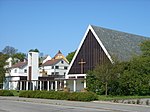
Stavanger/Sandnes is the third largest urban area in Norway. It consists of the densely built-up areas in the municipalities of Stavanger, Sandnes, Sola, and Randaberg, most of which are located on the Stavanger Peninsula, its surrounding islands, and the mainland south of the peninsula. Stavanger/Sandnes is the central part of the Stavanger Region. On 1 January 2021, the 80.09-square-kilometre (30.92 sq mi) urban area had a population of 229,911. This gives the urban area a population density of 2,871 inhabitants per square kilometre (7,440/sq mi). The area has had a big growth in population, and is one of the fastest growing urban areas in Norway. It is expected that larger portions of Sola municipality will grow together with the urban area in the future.

Excerpt from the Wikipedia article Stavanger/Sandnes (License: CC BY-SA 3.0, Authors, Images).

Stavanger/Sandnes
Færøygata, Stavanger Eiganes (Eiganes og Våland)

Geographical coordinates (GPS) Address Nearby Places
placeShow on map

Wikipedia: Stavanger/SandnesContinue reading on Wikipedia

Geographical coordinates (GPS)

Latitude Longitude
N 58.965 ° E 5.7177777777778 °
placeShow on map

Address

Færøygata 45
4009 Stavanger, Eiganes (Eiganes og Våland)
Norway
mapOpen on Google Maps

Stavanger sandnes tettsted 2005
Share experience

Nearby Places

Gamle Stavanger
Gamle Stavanger

Gamle Stavanger is a historic area of the city of Stavanger in Rogaland, Norway. The area consists largely of restored wooden buildings which were built in the 18th century and at the beginning of the 19th century.In the aftermath of World War II, a new city plan was created for Stavanger. It included razing most of the old wooden buildings in the city centre and replacing them with new modern structures in concrete. One single voice spoke up against this plan, and today it is recognized that Gamle Stavanger owes its existence to Einar Hedén (1916-2001), then City Architect of Stavanger. In 1956 the city council voted to conserve part of the old city centre.The area selected for conservation was the one considered the least desirable, consisting of small rundown wooden buildings located on the western side of Vågen, the inner harbor area of Stavanger. This area has a selection of preserved wood houses dating from both the 19th and 20th century. Some of the houses are owned by the municipality, but most are privately owned. Over the years the area has changed from seedy to trendy, and today is considered a choice location for the urban-minded with a sense of history. Gamle Stavanger has grown such that it now covers more than 250 buildings most of which are small, white wooden cottages. The area also includes the Norwegian Canning Museum which displays a typical factory from the 1920s.The Municipality of Stavanger has received several awards for the preservation of Gamle Stavanger. During the Council of Europe's 1975 European Architectural Year, Gamle Stavanger, together with the historic fishing village of Nusfjord in Nordland and the former mining town of Røros in Sør-Trøndelag, were identified as examples of how conservation of old buildings may well coincide with use, and how rehabilitation can be done without loss of character.