place

Estonian Students' Society

1870s establishments in EstoniaStudent organizations established in 1870Student organizations in EstoniaUniversity of Tartu
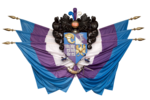
EYSi vapp
EYSi vapp

The Estonian Students' Society (Estonian: Eesti Üliõpilaste Selts; commonly used acronym: EÜS) is the largest and oldest all-male academical student society in Estonia, and is similar to the Baltic German student organizations known as corporations (Corps) (not to be confused with US college fraternities). It was founded in 1870 at Tartu. It has over 900 members in Estonia and abroad. In 1881 the Society adopted blue, black and white as its colours. Its first flag was made in 1884 and this tricolour was later (1918) accepted as the National Flag of Estonia. The original flag is still in existence. In the wake of the Estonian national awakening, many young Estonian intellectuals had ties to the EÜS, and the organization had impact beyond its borders. It was instrumental in the founding of the Estonian National Museum in 1909, and the EÜS library was donated to the museum. The Museum was later split into two, and its Archive Library formed the basis of the Estonian Literary Museum. The building of the Estonian Students' Society in Tartu has been considered to be one of the first examples of Estonian national architecture. The Treaty of Tartu between Finland and Soviet Russia was signed in the building in 1920. Former members of the EÜS founded the academic corporations Fraternitas Estica (1907), Sakala (1909) and the association Veljesto.

Excerpt from the Wikipedia article Estonian Students' Society (License: CC BY-SA 3.0, Authors, Images).

Estonian Students' Society
Jaan Tõnissoni, Tartu

Geographical coordinates (GPS) Address Nearby Places
placeShow on map

Wikipedia: Estonian Students' SocietyContinue reading on Wikipedia

Geographical coordinates (GPS)

Latitude Longitude
N 58.376472222222 ° E 26.710380555556 °
placeShow on map

Address

Eesti Üliõpilaste Selts

Jaan Tõnissoni 1
50409 Tartu
Estonia
mapOpen on Google Maps

EYSi vapp
EYSi vapp
Share experience

Nearby Places

Korporatsioon Sakala

Korporatsioon Sakala (abbreviated Korp! Sakala) is a fraternal organization of Estonian higher education students. It was established at the University of Tartu on November 14, 1909. The motto of korp! Sakala is One for all, and all for one! Its principles are natio, democratia and fraternitas, which are represented by the colors blue, violet and white as well the main principles of korp! Sakala are national loyalty, patriotism, promoting education, healthy living and physical recreation. The goal of korp! Sakala is to strengthen the academic bonds and support its members both morally and materially. With its activities Sakala intends to improve Estonia’s self-governance, preserve and advance its culture and to support realization of the ideas of democracy. Korp! Sakala's convent house is one of the architectural masterpieces in Tartu, planned by renowned Finnish national architect's Armas Lindgren and Wivi Lönn and completed in 1911. The high ceilings, prominent hall and plenty of space make it ideal for a student corporation. In 1941 the building was hit with a flame bomb and the only thing that survived was the walls. During the Second World War it was used as a medical station and command post. After the war ended, the building was given to the Tartu Art School. Forty years later, the house was returned to Sakala by the municipality and with great effort from Sakala's members and support from abroad, it was finally renovated a couple of years later. During the Soviet annexation of Estonia, korp! Sakala was banned for nearly 50 years. It was officially reinstated with University of Tartu on May 12, 1989.