place

Peel railway station

Peel, Isle of ManRailway stations closed in 1968Railway stations in the Isle of ManRailway stations opened in 1873Use British English from November 2013
Peel station 1972
Peel station 1972

Peel Railway Station (Manx: Stashoon Raad Yiarn Phurt ny h-Inshey) was a terminus on the Isle of Man Railway; it served the city of Peel in the Isle of Man and was the final stopping place on a line that ran between Douglas and the city. It was part of the island's first railway line.

Excerpt from the Wikipedia article Peel railway station (License: CC BY-SA 3.0, Authors, Images).

Peel railway station
East Quay,

Geographical coordinates (GPS) Address Website Nearby Places
placeShow on map

Wikipedia: Peel railway stationContinue reading on Wikipedia

Geographical coordinates (GPS)

Latitude Longitude
N 54.2219 ° E -4.6974 °
placeShow on map

Address

House of Manannan

East Quay

Isle of Man
mapOpen on Google Maps

Website
gov.im

linkVisit website

Peel station 1972
Peel station 1972
Share experience

Nearby Places

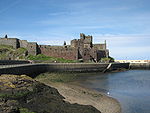
Peel Castle
Peel Castle

Peel Castle (Cashtal Phurt ny h-Inshey in Manx Gaelic) is a castle in Peel on the Isle of Man, originally constructed by Norwegians. The castle stands on St Patrick's Isle which is connected to the town by a causeway. It is now owned by Manx National Heritage and is open to visitors during the summer. The castle was built in the 11th century by Norwegians, under the rule of King Magnus Barefoot. While there were older stone Celtic monastic buildings on the island, the first Norwegian fortifications were built of wood. The prominent round tower was originally part of the Celtic monastery, but had battlements added at a later date. In the early 14th century, the majority of the walls and towers were built primarily from local red sandstone, which is found abundantly in the area. After the rule of Norway, the castle continued to be used by the Church due to the cathedral built there – the see of the diocese of Sodor and Man – but was eventually abandoned in the 18th century. The castle remained fortified, and new defensive positions were added as late as 1860. The buildings within the castle are now mostly ruined, but the outer walls remain intact. Excavations in 1982-87 revealed an extensive graveyard as well as the remains of Magnus Barefoot's original wooden fort. The most spectacular finds were the 10th century grave of "The Pagan Lady" which included a fine example of a Norwegian necklace and a cache of silver coins dating from about 1030. The Castle's most famous "resident" is the so-called Moddey Dhoo or "Black Dog" ghost. Peel Castle features today on the reverse side of the banknotes of the Manx Pound £10 notes issued by the Isle of Man Government.Peel Castle may occasionally be confused with Piel Castle, located on Piel Island, to the east across the Irish Sea. This particularly occurs in reference to the William Wordsworth poem describing Piel, spelling its name as 'Peele': especially as Wordsworth is documented as having visited Peel Castle, and wrote several times about the Isle of Man.Peel Castle has been proposed as a possible location of the Arthurian Avalon.

Knockaloe railway station and branch line

Knockaloe railway station served Knockaloe Internment Camp in the Isle of Man between 1915 and 1920. The station was at the end of a short branch line off the Douglas to Peel line of the Isle of Man Railway (IMR). The line left the IoMR on the outskirts of Peel near Glenfaba Mills and climbed steeply in a southerly direction for about 0.7 miles (1.1 km) until it reached the village of Patrick. The line then turned west along the access road into the internment camp which had been built in the grounds of Knockaloe Farm. The total length of the branch line was about 1.2 miles (1.9 km). The branch, and Knockaloe station at its terminus, opened on 1 September 1915 and closed on 14 October 1920. The station and line were used to transport internees, other persons, food and supplies to and from the camp. Few photographs survive of this line, but the locomotive shed is still in existence. In addition to the loco shed, traces include the remains of concrete bridge abutments on the old course of the River Neb at the end of an embankment which crosses a section of ground called the Raggat. The line was worked by the ex-MNR No.4/IMR No.15 0-6-0 locomotive "Caledonia". Materials used to build the line were acquired from an Irish 5' Gauge railway and were removed and shipped off the Island after the line ceased operation. Knockaloe Farm is now government owned. In addition to the line there was a harbour tramway built on the northern side of Peel Harbour running as far as the pier. Pictorial evidence of this is provided by a postcard illustrating 'the sale of fish at Peel'.