place

Sokolniki District

Districts of MoscowEastern Administrative OkrugPages with non-numeric formatnum argumentsUse mdy dates from April 2013
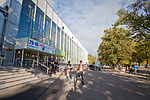
Sokolniki District, Moscow, Russia panoramio (105)

Sokolniki District (Russian: райо́н Соко́льники) is a district of the Eastern Administrative Okrug of the federal city of Moscow located in the north-east corner of the city. Population: 57,444 (2010 Census); 54,975 (2002 Census).

Excerpt from the Wikipedia article Sokolniki District (License: CC BY-SA 3.0, Authors, Images).

Sokolniki District
проезд Сокольнического Круга, Moscow Sokolniki (Sokolniki District)

Geographical coordinates (GPS) Address Nearby Places
placeShow on map

Wikipedia: Sokolniki DistrictContinue reading on Wikipedia

Geographical coordinates (GPS)

Latitude Longitude
N 55.794722222222 ° E 37.676388888889 °
placeShow on map

Address

Фонтан "Сокольники"

проезд Сокольнического Круга
107014 Moscow, Sokolniki (Sokolniki District)
Moscow, Russia
mapOpen on Google Maps

Sokolniki District, Moscow, Russia panoramio (105)
Share experience

Nearby Places

Sokolniki Park
Sokolniki Park

Sokolniki Park, named for the falcon hunt of the Grand Dukes of Muscovy formerly conducted there, is located in the eponymous Sokolniki District of Moscow. Sokolniki Park is not far from the center of the city, near Sokolnicheskaya Gate. The park gained its name from the Sokolnichya Quarter, the 17th-century home of the sovereign's falconers (sokol (сокол) is the Russian word for falcon). It was created by Tsar Alexei Mikhailovich (father of Peter the Great), a keen hunter who loved to go falconing in the area. The park's current layout of clearings and alleys began under Tsar Peter the Great. In 1900 a "labyrinth", or network of alleys, was laid out. Today Sokolniki is a typical Russian park, with an aging funfair and other amusements for children, and numerous fast food stalls all clustered near the main entrance. In summer the central alleyways are a mass of brightly colored formal flowerbeds, while the depths of the park are a wilderness home to pines and spruces, birches and oaks, limes and maples - all trees native to the Moscow region - as well as a number of non-indigenous trees, such as larches, cedars, walnut, red oaks, etc. The park's wildlife includes hares, squirrels and weasels, as well as 76 types of bird. It was established as a public municipal park in 1878. From 1931 onwards Sokolniki has been developed as an official "park of culture and leisure". The park, with an area of six square kilometers, is also the most Western extension of a larger Losiny Ostrov natural reserve that spans from the Eastern edge of Sokolniki to MKAD ring road and beyond. The park territory contains an amusement park, a winter outdoor ice skating rink and an exposition centre which was the site of the Kitchen Debate between Richard Nixon and Nikita Khrushchev at the American National Exhibition in 1959. It also contains the Sokolniki Sports Palace, home to the ice hockey team HC Spartak Moscow. The soccer club in Sokolniki was the site of the 2006 murder of Central Bank executive Andrey Kozlov.

Yelokhovo Cathedral
Yelokhovo Cathedral

The Epiphany Cathedral at Yelokhovo (Russian: Богоявленский собор в Елохове), Moscow, is the vicarial church of the Moscow Patriarchs. The surviving building was designed and built by Yevgraph Tyurin in 1837–1845. The original church in the village of Yelokhovo near Moscow was built in 1722-31 for Tsarevna Praskovia Ivanovna. It was there that Alexander Pushkin was baptized in 1799. In 1790 a refectory with a four-tier belfry was built. The present structure was erected in 1837-1845 to a Neoclassical design by Yevgraph Tyurin. The architecture is typical for the late Empire style, with some elements of European eclectics. The riotous opulence of the interior decoration is due to a restoration undertaken in 1912. Upon closing the Kremlin Cathedrals (1918) and the subsequent destruction of both the Cathedral of Christ the Savior (1931) and the Dorogomilovo Cathedral (1938), the chair of Russian Orthodox Church was moved to Yelokhovo, the largest remaining open church in Moscow. The enthronements of Patriarchs Sergius I (1943), Alexius I (1945), Pimen (1970), and Alexius II (1990) took place there. The church has been well-maintained, even in the Soviet era, and is known to have a 1970 air conditioning system using deep subterranean water from a 250 meters (820 ft)-deep artesian aquifer. The Christmas and Easter night services, which featured President Boris Yeltsin and Patriarch Alexius II, were aired on national television until the consecration of the rebuilt Cathedral of Christ the Savior in 2000. The main altar is devoted to the Epiphany and the Baptism of Jesus. The cathedral has two side-chapels: the left one of Saint Nicholas and the right one of the Annunciation. The most popular shrines of the cathedral are those that house the relics of St. Alexius of Moscow and the Kazan Icon of the Mother of God.