place

Oregon Institute of Marine Biology

Biological research institutes in the United StatesBuildings and structures in Coos County, OregonEducation in Coos County, OregonMarine biologyResearch institutes in Oregon
University of Oregon
Oimb campus
Oimb campus

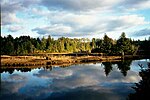
The Oregon Institute of Marine Biology (or OIMB) is the marine station of the University of Oregon. This 100-acre (0.40 km2) marine station is located in Charleston, Oregon at the mouth of Coos Bay. Currently, OIMB is home to several permanent faculty members and a number of graduate students. OIMB is a member of the National Association of Marine Laboratories (NAML). In addition to graduate research, undergraduate classes are offered year round, including marine birds and mammals, estuarine biology, marine ecology, invertebrate zoology, molecular biology, biology of fishes, biological oceanography, and embryology.The Loyd and Dorothy Rippey Library, one of eight branches of the UO Libraries, was added to the campus in 1999. The Rippey Library is open to the public by appointment, and the Oregon Card Program allows Oregon residents 16 years old and over to borrow from the collection.The Charleston Marine Life Center (or CMLC) is a public museum and aquarium on the edge of the harbor in Charleston, OR, across the street from the OIMB campus. Displays aimed at visitors of all ages emphasize the diversity of animal and plant life in local marine ecosystems. Visitors learn where to interact with marine organisms in their natural environments and how local scientists study the life histories, evolution and ecology of underwater plants and animals.

Excerpt from the Wikipedia article Oregon Institute of Marine Biology (License: CC BY-SA 3.0, Authors, Images).

Oregon Institute of Marine Biology
Boat Basin Road,

Geographical coordinates (GPS) Address Website External links Nearby Places
placeShow on map

Wikipedia: Oregon Institute of Marine BiologyContinue reading on Wikipedia

Geographical coordinates (GPS)

Latitude Longitude
N 43.3441 ° E -124.3281 °
placeShow on map

Address

Oregon Institute of Marine Biology

Boat Basin Road 63466
97420
Oregon, United States
mapOpen on Google Maps

Website
oimb.uoregon.edu

linkVisit website

linkWikiData (Q7101241)
linkOpenStreetMap (871587067)

Oimb campus
Oimb campus
Share experience

Nearby Places

Camp Castaway

Camp Castaway was a military encampment at what is now Coos Bay, Oregon, United States. It was established by the survivors of the wreck of the Captain Lincoln, a U.S. transport schooner, on January 3, 1852. The ship began taking on water during a storm while en route from San Francisco to Fort Orford at the town of Port Orford. To avoid sinking, the captain decided to beach the ship north of Cape Arago. All of the roughly 30 troops (U.S. 1st Dragoons, Company C, predecessors to the U.S. Cavalry) on board, and the ship's crew, survived the wreck and most of the cargo was salvaged. At the time no U.S. settlement was present at Coos Bay, so commanding officer Lt. Henry Stanton decided to establish the camp to protect the cargo until it could be transported to Fort Orford, some 50 miles south on the Oregon Coast. The troops and crew used spars, booms and sail cloth from the schooner to build tent structures for housing and for protecting the cargo from winter rains and blowing sand. They named the temporary post Camp Castaway. The camp endured for four months in the open dunes with help from Native Americans of the Coos tribe who traded fresh foods to the soldiers for silverware, biscuits and other nonlocal goods.The archaeological remains of Camp Castaway were located by archaeologist Scott Byram during a survey in March, 2010, using 150-year-old archival records and maps he studied at the United States Coast Survey archives in Maryland. It was subsequently designated Oregon archaeological site 35CS277. The site is located on land administered by the Bureau of Land Management, Coos Bay District. Following discovery of the site, BLM archaeologist Steve Samuels assembled a team from Southern Oregon University Laboratory of Anthropology, the Confederated Tribes of Coos, Lower Umpqua and Siuslaw Indians, and the Coquille Indian Tribe to excavate the site. Lead archaeologist Mark Tveskov of SOU concluded that the site was Camp Castaway based on the distinctive artifacts recovered. NOAA archaeologists Robert Schwemmer and James Delgado and historian John Cloud are also research team members. A full report of these excavations was due for publication in fall 2014.