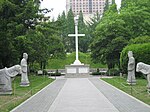
Xuhui District

Xuhui District is a core urban district of Shanghai. It has a land area of 54.76 km2 (21.14 sq mi) and a population of 982,200 as of 2008.The Xuhui District is named after its namesake, the historic area of Xujiahui. Xujiahui was historically land owned by Ming dynasty bureaucrat and scientist Xu Guangqi, and later donated to the Roman Catholic Church. It and Luwan District jointly formed the core of Catholic Shanghai, centered in the former French Concession of Shanghai. Vestiges of the French influence can still be seen in the St. Ignatius Cathedral of Shanghai, Xuhui College, the Xujiahui Observatory, and some remaining boulevards and French-style districts. Parts of today's Xuhui District were once the premier residential districts of Shanghai. The former french neighborhoods in parts of Xuhui today constitute some of the city´s most popular café areas, including places such as pedestrian Tianzifang. After the revolution, however, the large estates near Xujiahui were turned into factories. In the 1990s, the Shanghai municipal government developed the district as a commercial zone. A once-prominent commercial area in the district was the Xiangyang Crafts and Gifts Market, a haven for souvenirs and intellectual property-infringing products; it was closed on June 30, 2006 by municipal authorities. Xujiahui itself has been redeveloped as a financial center, with a proliferation of large-scale shopping centers and department stores, and is now a major shopping destination in the city with shopping malls such as Grand Gateway Shanghai and Pacific Sogo. The educational tradition begun by Jesuits in Xuhui continues with Shanghai Jiao Tong University, the premier university in China. The district also has some of the best secondary schools in the municipality, such as South West Weiyu Middle School, Shanghai High School and Nanyang Model High School. A number of former residences of prominent personalities remain, including Soong Ching-ling and Sun Yat-sen's former residence. Yao Ming of Houston Rockets was a resident of the district. Luo "Ferrari 430" Feichi lives in Xuhui.Xuhui District has 12 subdistricts and two townships.
Excerpt from the Wikipedia article Xuhui District (License: CC BY-SA 3.0, Authors, Images).Xuhui District
Tiyuchang Ring Road, Xuhui District
Geographical coordinates (GPS) Address Nearby Places Show on map
 Continue reading on Wikipedia
 Geographical coordinates (GPS)
| Latitude | Longitude |
|---|---|
| N 31.183333333333 ° | E 121.43333333333 ° |
Address
上海体育馆
Tiyuchang Ring Road
200243 Xuhui District
China
Open on Google Maps