place

Visoko

Municipalities of Zenica-Doboj CantonPages with Serbo-Croatian IPAPopulated places established in the 5th millennium BCPopulated places in VisokoVisoko
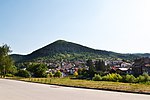
Visoko from the Visočica hill

Visoko (Serbian Cyrillic: Високо, pronounced [ʋǐsɔkɔː]) is a city located in the Zenica-Doboj Canton of the Federation of Bosnia and Herzegovina, an entity of Bosnia and Herzegovina. As of 2013, the municipality had a population of 39,938 inhabitants with 11,205 living in Visoko town. Located between Zenica and Sarajevo, Visoko lies where the river Fojnica joins the Bosna. The Visoko region has evidence of long continuous occupation, with the first traces of life dating back to the 5th millennium BC. Archaeological excavations of Okolište have found one of the biggest neolithic settlements of the Butmir culture in southeastern Europe.It was an early political and commercial center of the Bosnian medieval state, and the site where the first Bosnian king Tvrtko I was crowned. The Old town Visoki, located on Visočica hill, was a politically important fortress, and its inner bailey Podvisoki was an early example of a Bosnian medieval urban area. After the fall of the Kingdom of Bosnia, medieval Visoko grew as an Ottoman town. A key role in its development was played by the local Bosnian Ajas-pashaOttoman rule ended in 1878 when the Bosnian Vilayet was occupied by Austria-Hungary. On 11 November 1911, in the last years of Austro-Hungarian rule, it was almost completely burned down by an accidental fire. Before the Bosnian War, Visoko was the largest exporter of textile and leather in socialist Yugoslavia As of 2006, Visoko attracts tens of thousands of tourists every year, mainly because of Semir Osmanagić's claims.

Excerpt from the Wikipedia article Visoko (License: CC BY-SA 3.0, Authors, Images).

Geographical coordinates (GPS)

Latitude Longitude
N 43.983333333333 ° E 18.166666666667 °
placeShow on map

Address


71300
Federation of Bosnia and Herzegovina, Bosnia and Herzegovina
mapOpen on Google Maps

Visoko from the Visočica hill
Share experience

Nearby Places

Bosnian pyramid claims

The Bosnian pyramid claims are pseudoarchaeological theories put forward to explain the formation of a cluster of natural hills in the area of Visoko in central Bosnia and Herzegovina. Since 2005, Semir Osmanagić, a Bosnian-American businessman based in Houston, Texas, has claimed that these hills are the largest human-made ancient pyramids on Earth. His claims have been overwhelmingly refuted by scientists but he has proceeded to promote the area as a tourist attraction.Direct study of the site by geologists, archaeologists, and other scientists has demonstrated that the hills are natural formations known as flatirons, and that there is no evidence that they were shaped by human construction. The European Association of Archaeologists has condemned the so-called 'Bosnian pyramids' as a "cruel hoax"; along with various other scholars they are also concerned about damage being done to genuine archaeological and paleontological sites: a medieval Bosnian castle, Roman fortifications, and some even more ancient remains. Osmanagić initiated excavations in 2006 and has since reshaped one of the hills, making it look like a stepped pyramid. The academic community has called for the government to end funding of excavations and disruption of the site because of the damage to true archaeological resources.Many scholars have noted that the claims have been used for serious ideological, political and economic gains by various factions in Bosnia. Although Osmanagić's claims have been completely disproved by the scientific community, the Visoko area in recent years has attracted pseudoscience enthusiasts; the so-called Bosnian pyramids and the Ravne tunnels have been morphed into "New Age pilgrimage sites." By June 2016, Osmanagić had completed an "archaeological park" at one of the hills, where he attracts volunteers who are constructing botanical gardens; meditation sessions have been held at the site. It has been noted that tourist traffic has aided the economy of the city of Visoko, located near the front of the war that destroyed so much of the country in the late 20th century. As of 2017, Osmanagić continued to make alterations to the hills and add to his marketing about them. His work at the time was based on private funding.