place

Battle of Broken Hill

1915 in AustraliaAustralia in World War IBroken Hill, New South WalesConflicts in 1915Crime in New South Wales
History of AustraliaIslamic terrorism in AustraliaJanuary 1915 eventsMass murder in 1915Mass murder in AustraliaNationalist terrorismRebellions in AustraliaSpree shootings in AustraliaTerrorism in AustraliaUprisings during World War IUse Australian English from March 2018

The Battle of Broken Hill, also known as Broken Hill massacre, was an incident that took place near the Australian town of Broken Hill, New South Wales, on 1 January 1915. Two Muslim former camel drivers from colonial India who supported the Ottoman Empire—Badsha Mahommed Gool and Mullah Abdullah—shot dead four people and wounded seven others before being killed by the police and local vigilantes. Although the attacks were politically and religiously motivated, the men were not members of any sanctioned armed force. Three days after the attack, the pair's suicide notes were discovered by a miner. Mullah Abdullah's note suggested he was motivated primarily by personal grievances against a local food safety inspector. The incident has been described as Australia's first terrorist attack. In 1995, Australia's Turkish community announced plans to create a memorial in honour of Gool and Abdullah and the Turkish embassy in Canberra requested that the assailants' remains be handed over to the Turkish government for burial in that country. In 2014, the mayor of Broken Hill requested that the Australian government help finance a ceremony marking the one-hundredth anniversary of the incident. The request was rejected by the government, but the ceremony was held regardless. The attack has been dramatised in film, literature and art.

Excerpt from the Wikipedia article Battle of Broken Hill (License: CC BY-SA 3.0, Authors).

Battle of Broken Hill
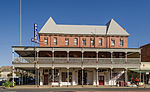
Argent Street, Broken Hill

Geographical coordinates (GPS) Address Phone number Nearby Places
placeShow on map

Wikipedia: Battle of Broken HillContinue reading on Wikipedia

Geographical coordinates (GPS)

Latitude Longitude
N -31.956666666667 ° E 141.46777777778 °
placeShow on map

Address

The Broken Hill Pub

Argent Street 400
2880 Broken Hill
New South Wales, Australia
mapOpen on Google Maps

Phone number

call+61880876870

Share experience

Nearby Places

Far West (New South Wales)

The Far West region of New South Wales, Australia refers generally to the western part of the state, which is too dry to support wheat or other crops or intensive pastoral endeavours. It is west of the North West Slopes, Central West and the Riverina. It is an area with limited rainfall, and the only major rivers found in it are the Darling River and the Murray River (on its southern edge), which originate in the Great Dividing Range to the east. The region corresponds to the combination of the Australian Bureau of Meteorology's forecast areas of Upper Western and Lower Western. It also corresponds to the Western Division established under the New South Wales Western Lands Act 1901. Its only city is Broken Hill, and other significant towns are Bourke, Brewarrina, Cobar, Ivanhoe and Wentworth. Ninety-five per cent of the region is uncleared. Major economic activities are mining and extensive pasturing. During good seasons in the 1870s and 1880s, large sheep stations were established with high stocking rates, partly in response to a widespread belief that the introduction of agriculture would cause climate change toward European conditions. The error of this "rain follows the plough" concept was exposed by the droughts of the 1890s, and many of the stations established during this period were subsequently abandoned. The Far West region is traversed by the Barrier Highway, the Silver City Highway, the Mitchell Highway, the Cobb Highway and the Sturt Highway and by the Sydney-Perth Railway.

Broken Hill Women's Memorial

Broken Hill Women's Memorial is located in the Town Square of Broken Hill, New South Wales, Australia, and honours the contribution of women to the Broken Hill community. In particular, it acknowledges the work of women who supported the town's miners during long and difficult strikes and industrial disputes. Some of these women organised themselves into the Women's Brigade (Broken Hill). Their work included picketing outside the mine, organising protest marches and rallies, and tarring and feathering non-unionised workers (strikebreakers, known as scabs) who tried to enter the mine during strikes.The memorial was partially funded from a surplus of money raised by the women of Broken Hill during an industrial dispute at the mine in 1986. As had been the case in previous strikes in 1892 and 1919, the women of the town supported the men by organising financial support, as well as providing ongoing moral support and encouragement. When the 1986 dispute ended and the women's fund still held $1,000, it was decided to use the money to build a memorial. The balance of the funds was provided by the miners' union.The memorial is built from two pieces of black granite and was constructed by Zanon Memorials. It depicts an image of a family and two pieces of text. The unveiling ceremony took place on 30 March 2001, and was performed by Martin Ferguson, Shadow Minister for Regional Development, Transport, Infrastructure, Regional Services and Population. The president of the Construction, Forestry, Mining and Energy Union, Eddie Butcher, was also present and dedicated the memorial with the words "[Women] were the unsung heroes as they stood by their men, through the toughest and darkest hours of mining history. Women are the backbone of Broken Hill's society and they truly deserve the recognition that this monument will give them."

Broken Hill
Broken Hill

Broken Hill is a city in the far west region of outback New South Wales, Australia. An inland mining city, is near the border with South Australia on the crossing of the Barrier Highway (A32) and the Silver City Highway (B79), in the Barrier Range. It is 315m above sea level, with a hot desert climate, and an average rainfall of 235mm. The closest major city is Mildura, 300 km to the south and the nearest State Capital City is Adelaide, the capital of South Australia, which is more than 500 km to the southwest and linked via route A32. The town is prominent in Australia's mining, industrial relations and economic history after the discovery of silver ore led to the opening of various mines, thus establishing Broken Hill's recognition as a prosperous mining town well into the 1990s. Despite experiencing a slowing economic situation into the late 1990s and 2000s, Broken Hill itself was listed on the National Heritage List in 2015 and remains Australia's longest running mining town. Broken Hill, historically considered one of Australia's boomtowns, has been referred to as "The Silver City", and less commonly as the "Oasis of the West", and the "Capital of the Outback". Although over 1100 km west of Sydney and surrounded by desert, the town has prominent park and garden displays and offers a number of attractions, such as the Living Desert Sculptures. The town has a high potential for solar power, given its extensive daylight hours of sunshine. In the Broken Hill region the major Aboriginal language groups are the Paakantji, Mayyankapa, and Nyiimpaa.