place

Madeira Island

Holocene shield volcanoesIslands of the Autonomous Region of MadeiraMadeira IslandMiocene shield volcanoesPleistocene shield volcanoes
Pliocene shield volcanoesPolygenetic shield volcanoes
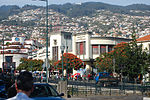
Funchal, Madeira
Funchal, Madeira

Madeira is a Portuguese island, and is the largest and most populous of the Madeira Archipelago. It has an area of 740.7 km2 (286 sq mi), including Ilhéu de Agostinho, Ilhéu de São Lourenço, Ilhéu Mole (northwest). As of 2011, Madeira had a total population of 262,456. The island is the top of a massive submerged shield volcano that rises about 6 km (3.7 mi) from the floor of the Atlantic Ocean. The volcano formed atop an east–west rift in the oceanic crust along the African Plate, beginning during the Miocene epoch over 5 million years ago, continuing into the Pleistocene until about 700,000 years ago. This was followed by extensive erosion, producing two large amphitheatres open to south in the central part of the island. Volcanic activity later resumed, producing scoria cones and lava flows atop the older eroded shield. The most recent volcanic eruptions were on the west-central part of the island only 6,500 years ago, creating more cinder cones and lava flows.Madeira is the largest island of the group with an area of 741 km2 (286 sq mi), a length of 57 km (35 mi) (from Ponta de São Lourenço to Ponta do Pargo), while approximately 22 km (14 mi) at its widest point (from Ponta da Cruz to Ponta de São Jorge), with a coastline of 150 km (90 mi). It has a mountain ridge that extends along the centre of the island, reaching 1,862 m (6,109 ft) at its highest point (Pico Ruivo), while much lower (below 200 m or 660 ft) along its eastern extent. The primitive volcanic foci responsible for the central mountainous area, consisted of the peaks: Ruivo (1,862 m or 6,109 ft), Torres (1,851 m or 6,073 ft), Arieiro (1,818 m or 5,965 ft), Cidrão (1,802 m or 5,912 ft), Cedro (1,759 m or 5,771 ft), Casado (1,725 m or 5,659 ft), Grande (1,657 m or 5,436 ft), Ferreiro (1,582 m or 5,190 ft). At the end of this eruptive phase, an island circled by reefs was formed, its marine vestiges are evident in a calcareous layer in the area of Lameiros, in São Vicente (which was later explored for calcium oxide production). Sea cliffs, such as Cabo Girão, valleys and ravines extend from this central spine, making the interior generally inaccessible. Daily life is concentrated in the many villages at the mouths of the ravines, through which the heavy rains of autumn and winter usually travel to the sea.

Excerpt from the Wikipedia article Madeira Island (License: CC BY-SA 3.0, Authors, Images).

Madeira Island
Rua dos Netos, Funchal São Pedro

Geographical coordinates (GPS) Address Nearby Places
placeShow on map

Wikipedia: Madeira IslandContinue reading on Wikipedia

Geographical coordinates (GPS)

Latitude Longitude
N 32.651111111111 ° E -16.909722222222 °
placeShow on map

Address

Ateneu

Rua dos Netos
9000-084 Funchal, São Pedro
Portugal
mapOpen on Google Maps

Funchal, Madeira
Funchal, Madeira
Share experience

Nearby Places

Roman Catholic Diocese of Funchal

The Diocese of Funchal (Latin: Dioecesis Funchalensis) is a Latin Church ecclesiastical territory or patriarchal archdiocese of the Catholic Church in Portugal. It was originally created on 12 June 1514 by the papal bull Pro excellenti præeminentia from Pope Leo X, following the elevation of Funchal from a village to the status of city, by King Manuel I of Portugal (Royal Decree of 21 August 1508). The diocese was a suffragan of the Archdiocese of Lisbon. Before the issuance of the papal bull, between 1433 and 1514 the civil and religious administrations were in charge of the Grand-Master of the Order of Christ. In fact all Portuguese Atlantic territories were under the jurisdiction of Order of Christ, until the situation changed in 1514 with the creation of the Diocese. Once the diocese was created, the bishop of Funchal had jurisdiction over the entire area occupied by the Portuguese in the Atlantic and Indian Oceans. Thus, the Diocese comprised not only the Islands of Madeira, but all the territories discovered or to be discovered by the Portuguese. Thus, its jurisdiction extended throughout the western and eastern African territory, Brazil and Asia. Given its jurisdiction extent, the diocese's first bishop, D. Diogo Pinheiro used the title of Primate.Nineteen years later, on 31 January 1533, the diocese was elevated to archiepiscopal rank. For twenty-two years it was, geographically, the largest metropolitan ecclesiastical province in the world, having as suffragan dioceses: Azores, Brazil, Africa and Goa. The first (and only) Archbishop was D. Martinho of Portugal, also held the title of Primate.Following the Portuguese Empire's economic and social progress new dioceses were created in 1534, whose areas were detached from the Diocese of Funchal: Goa, Angra, Santiago and São Tome, São Salvador da Bahia. Later, on January 31, 1533, the Diocese of Funchal was elevated to the category of metropolitan and primate. In 1551 Pope Julius III revoked the situation by passing Funchal to the simple suffrage bishopric of the Archdiocese of Lisbon, as it remains today.The first bishop to visit the diocese was D. Ambrósio Brandão, in 1538, on behalf of the diocesan bishop D. Martinho of Portugal. After the death of D. Martinho de Portugal, the only archbishop of Funchal, the cathedral remained vacant until 1551. One year later, in 1552, Fr. Gaspar do Casal, who did not reside on the island, was appointed, and the most salient fact of his action was his participation in the Council of Trent. His successors, D. Jorge de Lemos, D. Jerónimo Barreto and D. Luís Figueiredo de Lemos, applied the Council and were the true workers of this reform. The first bishop of Funchal to actually reside, full-time, after his appointment was D. Jorge de Lemos, in 1558.Throughout its more than five centuries of history the diocese has only be headed by two Madeirans so far: D. Aires de Ornelas e Vasconcelos, who would then become Archbishop of Goa, and D. Teodoro de Faria.Until the 20th century, the bishops of Funchal used the title of Bishop of Madeira, of Porto Santo, of Desertas and of Arguim. The seat of the Diocese of Funchal is the Cathedral of Our Lady of the Assumption. On 8 March 2007, Pope Benedict XVI appointed António Carrilho (António III) as Bishop of Funchal, until then Auxiliary Bishop of Porto. Together with Cardinal Fernando Filoni, António III, presided over the celebrations for the 500th anniversary of the foundation of the diocese on 17 May 2014.The current bishop of Funchal is Nuno I, who took office on February 17, 2019.