place

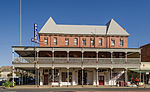
Sacred Heart Cathedral, Broken Hill

20th-century Roman Catholic church buildings in AustraliaInfobox religious building with unknown affiliationRoman Catholic cathedrals in New South Wales
BrokenHillRomanCatholicCathedral

Sacred Heart Cathedral, Broken Hill is the cathedral church of the Roman Catholic Diocese of Wilcannia-Forbes and the seat of the Catholic Bishop of Wilcannia-Forbes, currently the Most Reverend Columba Macbeth-Green OSPPE.

Excerpt from the Wikipedia article Sacred Heart Cathedral, Broken Hill (License: CC BY-SA 3.0, Authors, Images).

Sacred Heart Cathedral, Broken Hill
Lane Street, Broken Hill

Geographical coordinates (GPS) Address Website Nearby Places
placeShow on map

Wikipedia: Sacred Heart Cathedral, Broken HillContinue reading on Wikipedia

Geographical coordinates (GPS)

Latitude Longitude
N -31.953317697479 ° E 141.45827948682 °
placeShow on map

Address

Sacred Heart Parish School

Lane Street 192
2880 Broken Hill
New South Wales, Australia
mapOpen on Google Maps

Website
wf.catholic.edu.au

linkVisit website

BrokenHillRomanCatholicCathedral
Share experience

Nearby Places

Broken Hill
Broken Hill

Broken Hill is a city in the far west region of outback New South Wales, Australia. An inland mining city, is near the border with South Australia on the crossing of the Barrier Highway (A32) and the Silver City Highway (B79), in the Barrier Range. It is 315m above sea level, with a hot desert climate, and an average rainfall of 235mm. The closest major city is Mildura, 300 km to the south and the nearest State Capital City is Adelaide, the capital of South Australia, which is more than 500 km to the southwest and linked via route A32. The town is prominent in Australia's mining, industrial relations and economic history after the discovery of silver ore led to the opening of various mines, thus establishing Broken Hill's recognition as a prosperous mining town well into the 1990s. Despite experiencing a slowing economic situation into the late 1990s and 2000s, Broken Hill itself was listed on the National Heritage List in 2015 and remains Australia's longest running mining town. Broken Hill, historically considered one of Australia's boomtowns, has been referred to as "The Silver City", and less commonly as the "Oasis of the West", and the "Capital of the Outback". Although over 1100 km west of Sydney and surrounded by desert, the town has prominent park and garden displays and offers a number of attractions, such as the Living Desert Sculptures. The town has a high potential for solar power, given its extensive daylight hours of sunshine. In the Broken Hill region the major Aboriginal language groups are the Paakantji, Mayyankapa, and Nyiimpaa.

Broken Hill Women's Memorial

Broken Hill Women's Memorial is located in the Town Square of Broken Hill, New South Wales, Australia, and honours the contribution of women to the Broken Hill community. In particular, it acknowledges the work of women who supported the town's miners during long and difficult strikes and industrial disputes. Some of these women organised themselves into the Women's Brigade (Broken Hill). Their work included picketing outside the mine, organising protest marches and rallies, and tarring and feathering non-unionised workers (strikebreakers, known as scabs) who tried to enter the mine during strikes.The memorial was partially funded from a surplus of money raised by the women of Broken Hill during an industrial dispute at the mine in 1986. As had been the case in previous strikes in 1892 and 1919, the women of the town supported the men by organising financial support, as well as providing ongoing moral support and encouragement. When the 1986 dispute ended and the women's fund still held $1,000, it was decided to use the money to build a memorial. The balance of the funds was provided by the miners' union.The memorial is built from two pieces of black granite and was constructed by Zanon Memorials. It depicts an image of a family and two pieces of text. The unveiling ceremony took place on 30 March 2001, and was performed by Martin Ferguson, Shadow Minister for Regional Development, Transport, Infrastructure, Regional Services and Population. The president of the Construction, Forestry, Mining and Energy Union, Eddie Butcher, was also present and dedicated the memorial with the words "[Women] were the unsung heroes as they stood by their men, through the toughest and darkest hours of mining history. Women are the backbone of Broken Hill's society and they truly deserve the recognition that this monument will give them."