place

Illinois Field

1988 establishments in IllinoisBaseball venues in IllinoisBuildings and structures in Champaign, IllinoisBuildings and structures of the University of Illinois Urbana-ChampaignCollege baseball venues in the United States
Illinois Fighting Illini baseball venuesMinor league baseball venuesSports venues completed in 1988Sports venues in Champaign–Urbana, IllinoisTourist attractions in Champaign County, Illinois
Illinois Field Champaign IL

Illinois Field is a baseball venue in Champaign, Illinois, home to the University of Illinois Fighting Illini baseball team. It is located in the sports complex at the University of Illinois near the Champaign-Urbana border. It is a short distance east of State Farm Center and Memorial Stadium.

Excerpt from the Wikipedia article Illinois Field (License: CC BY-SA 3.0, Authors, Images).

Illinois Field
South Goodwin Avenue, Urbana

Geographical coordinates (GPS) Address Nearby Places
placeShow on map

Wikipedia: Illinois FieldContinue reading on Wikipedia

Geographical coordinates (GPS)

Latitude Longitude
N 40.096869 ° E -88.229796 °
placeShow on map

Address

South Goodwin Avenue
61801 Urbana
Illinois, United States
mapOpen on Google Maps

Illinois Field Champaign IL
Share experience

Nearby Places

Construction of Assembly Hall (Champaign)

The construction of State Farm Center, originally known as the Assembly Hall, at the University of Illinois at Urbana–Champaign consisted of building a huge indoor arena with a 400-foot-diameter (120 m) concrete dome whose center height is 125 feet (38 m) above the center floor, and which weighs 10 million pounds. The building is considered an engineering marvel because of the unique method used to build the concrete roof. State Farm Center, the first-ever concrete dome arena, hosts the campus's teams in men's and women's basketball, numerous concerts and other events. It holds sentimental value for numerous alumni and fans alike and attracts attention for its design and construction. The construction of the Assembly Hall was conceived to provide UIUC with needed space for ceremonies and athletic events. The university’s population had outgrown the largest building on campus at that time, the Auditorium (later rededicated Foellinger Auditorium), and desired one building that could hold the entire university class. The design of the new building, by Max Abramovitz, called for the construction of one of the world’s largest edge-supported structure. The assembly hall was completed in 1963, and was dedicated on Honors Day, Friday May 3.The arena was renamed State Farm Center in 2013 after the Illinois-based insurance company purchased the naming rights to the facility for $60 million over 30 years. The sale of naming rights provided a significant portion of the funding for a planned renovation of the facility.

Business Instructional Facility

The Gies College of Business Instructional Facility (BIF) is a state-of-the-art business facility designed by Pelli Clarke Pelli Architects located on the Champaign campus at the University of Illinois Urbana–Champaign (UIUC). The facility is home to numerous classrooms, career development and academic counseling centers, student program offices, a recruitment suite, a 300-seat auditorium, and a study area for students.Rafael Pelli, a partner of Pelli Clarke Pelli Architects who was the project principal for the Business Instructional Facility, explained in an interview on October 17, 2008 (shortly after completion) that the purpose of this building is to serve as "a sense of place, a community, a center to the College of Business".The building is the first business facility at a public university in the world to achieve a platinum certification through Leadership in Energy and Environmental Design (LEED), a U.S. Green Building Council rating system used to measure the sustainability in construction, and is the first building on the UIUC campus to achieve a LEED certification.The noteworthy 'green' elements of the Business Instructional Facility include solar panels, a green roof, and an energy-efficient cooling and heating system. The combined 'green' initiatives are expected to produce savings of $300,000 per year in comparison with traditional classroom buildings on the UIUC campus. The cost of construction was approximately $60 million and covers 160,000 sq ft (15,000 m2)

Huff Hall
Huff Hall

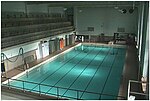
Huff Hall is a 4,050-seat multi-purpose arena in Champaign, Illinois, United States. The arena opened in 1925 and was known as Huff Gymnasium until the 1990s. It is named after George Huff, who was the school's athletic director from 1895 to 1935. Huff Hall is home to the University of Illinois Fighting Illini volleyball and wrestling teams. Prior to the opening of Assembly Hall in 1963, it was home to the basketball team as well. Currently Huff Hall is used for a variety of sporting events, including men's and women's gymnastics, men's wrestling, and women's volleyball. At each athletic event banners are hung of past Illini heroes to remind the crowd of the rich tradition that Illini athletics have had. Every March from 1926 to 1962, Huff Gymnasium played host to the state finals of the Illinois High School Association boys' basketball tournament. Huff Hall also served as the home of the women's basketball team. Beginning in the 1970s and continuing through the mid-1990s, the team once again used Huff Hall for home games, as it struggled to fill up the Assembly Hall. Since 1997 the team has used the Assembly Hall exclusively, although it struggles with a losing record and to fill up the Assembly Hall. From 1927 to 2002 Huff Hall was also home to a 25-yard swimming pool which served as the home of the University of Illinois at Urbana–Champaign Underwater Hockey club and the University of Illinois Water Polo Club. The pool had a consistent depth of 8 ft. which made it ideal for these activities. In addition to hosting athletic events, Huff Hall is also the home of the College of Applied Health Sciences.