place

NOKAS robbery

2004 mass shootings2004 murders in NorwayApril 2004 crimes in EuropeApril 2004 in EuropeAttacks on buildings and structures in 2004
Attacks on buildings and structures in NorwayBank robberiesCrimes adapted into filmsCrimes against police officers in NorwayMass shootings in NorwayNOKAS robberyOrganized crime events in NorwayRobberies in NorwayShootoutsStavanger
Domkirkeplassen Stavanger

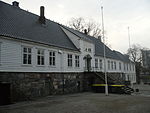
On 5 April 2004, at 8 AM the NOKAS cash depot in Stavanger, Norway was raided by heavily armed men. It was the biggest-ever heist in Norway. Although the police had intelligence that a raid was expected in the coming days, they were understaffed and unprepared because of Easter, a national holiday in Norway. That morning, a bulletin was issued warning the NOKAS depot was a possible target. Equipped to hold off the police, the gunmen wore bulletproof vests, helmets, ski masks, gloves and overalls, and were armed with automatic weapons and a .45 ACP pistol. Much of their equipment was military property from Madla Military Camp. The gunmen undertook extensive means to delay a police response while the NOKAS depot was attacked. The Stavanger Police HQ was blocked by a burning truck on the vehicle exit, smoke grenades were thrown at the front of the building and spike strips were spread across the road to burst the tires of police vehicles. The raiders planned to gain access through a window overlooking a courtyard at the centre of the office block, believing it would not be adequately protected as it was an old building. The raid was to last 8 minutes if all went to plan but it all began to unravel as it became clear the bank was protected by bullet-proof glass. To break the window, first a sledgehammer and a battering ram were used and then 113 shots were fired at the window with automatic weapons. During this time the employees escaped before seven gunmen finally gained access to the ground floor of the NOKAS building. Outside, several gunmen held positions on Cathedral Square at the front of the bank. When the police arrived, shots were exchanged with the gunmen. Police Lieutenant Arne Sigve Klungland was shot dead. The perpetrators escaped with 57.4 million kroner (~US$8 million in 2004) in national and foreign currencies, making it Norway's largest-ever robbery. Of the total, 51 million kroner are still to be recovered. The 37 NOKAS employees received compensation worth a total of nine million kroner due to the trauma they suffered during the robbery. This story is the basis for a movie titled Nokas, which premiered on 1 October 2010.

Excerpt from the Wikipedia article NOKAS robbery (License: CC BY-SA 3.0, Authors, Images).

NOKAS robbery
Haakon VIIs gate, Stavanger Ledaal (Eiganes og Våland)

Geographical coordinates (GPS) Address Nearby Places
placeShow on map

Wikipedia: NOKAS robberyContinue reading on Wikipedia

Geographical coordinates (GPS)

Latitude Longitude
N 58.969194 ° E 5.729889 °
placeShow on map

Address

Haakon VIIs gate 9
4005 Stavanger, Ledaal (Eiganes og Våland)
Norway
mapOpen on Google Maps

Domkirkeplassen Stavanger
Share experience

Nearby Places

Stavanger
Stavanger

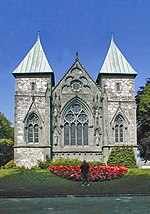
Stavanger (, UK also , US usually , Norwegian: [stɑˈvɑ̀ŋːər] ) is a city and municipality in Norway. It is the third largest city and third largest metropolitan area in Norway (through conurbation with neighboring Sandnes) and the administrative center of Rogaland county. The municipality is the fourth most populous in Norway. Located on the Stavanger Peninsula in southwest Norway, Stavanger counts its official founding year as 1125, the year the Stavanger Cathedral was completed. Stavanger's core is to a large degree 18th- and 19th-century wooden houses that are protected and considered part of the city's cultural heritage. This has caused the town center and inner city to retain a small-town character with an unusually high ratio of detached houses, and has contributed significantly to spreading the city's population growth to outlying parts of Greater Stavanger. The city's population rapidly grew in the late 20th century due to its oil industry. Stavanger is known today as the Oil Capital of Norway. Norwegian energy company Equinor, the largest company in the Nordic region, has its headquarters in Stavanger. Multiple educational institutions for higher education are located in Stavanger. The largest of these is the University of Stavanger. Domestic and international military installations are located in Stavanger, including the NATO Joint Warfare Centre. Other international establishments, and especially local branches of foreign oil and gas companies, contribute further to a significant foreign population in the city. The city has a strong international profile and 22,1% of the population has an immigrant background. In 2020, it was rated as the most liveable city for Europeans expatriates in Norway as well as 5th in Europe by ECA International. Stavanger has, since the early 2000s, consistently had an unemployment rate significantly lower than the European average. In August 2022, the unemployment rate was 1.6%. The city is also among those that frequent various lists of most expensive cities in the world, and Stavanger has even been ranked as the world's most expensive city by certain indices.The climate of the city is very mild by Nordic standards due to a strong maritime influence. As a result, winter usually remains above freezing whereas heat waves are rare and seldom long. Rainfall is common, although less so than in areas further north on the coastline. Stavanger is served by international airport Stavanger Airport, Sola, which offers flights to cities in most major European countries, as well as a limited number of intercontinental charter flights. The airport was rated as one of the world's most punctual airports of its category by OAG in 2020.Every two years, Stavanger organizes the Offshore Northern Seas (ONS), which is the second largest exhibition and conference for the energy sector. The Gladmat food festival is also held each year and is considered to be one of Scandinavia's leading food festivals. The city is also known for being one of the nation's premier culinary clusters. Stavanger was awarded the 2008 European Capital of Culture alongside Liverpool.

Gamle Stavanger
Gamle Stavanger

Gamle Stavanger is a historic area of the city of Stavanger in Rogaland, Norway. The area consists largely of restored wooden buildings which were built in the 18th century and at the beginning of the 19th century.In the aftermath of World War II, a new city plan was created for Stavanger. It included razing most of the old wooden buildings in the city centre and replacing them with new modern structures in concrete. One single voice spoke up against this plan, and today it is recognized that Gamle Stavanger owes its existence to Einar Hedén (1916-2001), then City Architect of Stavanger. In 1956 the city council voted to conserve part of the old city centre.The area selected for conservation was the one considered the least desirable, consisting of small rundown wooden buildings located on the western side of Vågen, the inner harbor area of Stavanger. This area has a selection of preserved wood houses dating from both the 19th and 20th century. Some of the houses are owned by the municipality, but most are privately owned. Over the years the area has changed from seedy to trendy, and today is considered a choice location for the urban-minded with a sense of history. Gamle Stavanger has grown such that it now covers more than 250 buildings most of which are small, white wooden cottages. The area also includes the Norwegian Canning Museum which displays a typical factory from the 1920s.The Municipality of Stavanger has received several awards for the preservation of Gamle Stavanger. During the Council of Europe's 1975 European Architectural Year, Gamle Stavanger, together with the historic fishing village of Nusfjord in Nordland and the former mining town of Røros in Sør-Trøndelag, were identified as examples of how conservation of old buildings may well coincide with use, and how rehabilitation can be done without loss of character.