place

Memphis Theological Seminary

1908 establishments in TennesseeEducational institutions established in 1908Memphis Theological SeminaryPresbyterian universities and colleges in the United StatesPresbyterianism in Tennessee
Seminaries and theological colleges in TennesseeUniversities and colleges accredited by the Southern Association of Colleges and SchoolsUniversities and colleges in Memphis, Tennessee
MemphisTheologicalSeminary

Memphis Theological Seminary is an ecumenical seminary of the Cumberland Presbyterian Church in Memphis, Tennessee. Although it is affiliated with the Cumberland Presbyterian Church, it accepts and trains ministerial candidates from other denominations as well. Besides the traditional Master of Divinity (MDiv), Memphis Theological Seminary also grants the Master of Arts in Christian Ministry (MACM) with concentrations in Social Justice, Christian Education, and Chaplaincy, as well as the Doctor of Ministry (DMin). It also administers the Cumberland Presbyterian denomination's Program of Alternate Studies or PAS. MTS is a continuation of the Cumberland Presbyterian Theological School. It was moved from the campus of Bethel College (now Bethel University) in McKenzie, Tennessee, to Memphis in 1964.The president is Jody Hill. The seminary is accredited by the Association of Theological Schools in the United States and Canada (ATS) and the Commission on Colleges and Schools of the Southern Association of Colleges and Schools (SACS). The seminary is also approved by the University Senate of the United Methodist Church to educate United Methodist theological students. The seminary is located in Midtown Memphis at the corner of Union Avenue and East Parkway, across town from the denominational Cumberland Presbyterian Center in Cordova, Tennessee.

Excerpt from the Wikipedia article Memphis Theological Seminary (License: CC BY-SA 3.0, Authors, Images).

Memphis Theological Seminary
Union Avenue, Memphis

Geographical coordinates (GPS) Address External links Nearby Places
placeShow on map

Wikipedia: Memphis Theological SeminaryContinue reading on Wikipedia

Geographical coordinates (GPS)

Latitude Longitude
N 35.132917 ° E -89.982855 °
placeShow on map

Address

Memphis Theological Seminary

Union Avenue
38112 Memphis
Tennessee, United States
mapOpen on Google Maps

linkWikiData (Q6815887)
linkOpenStreetMap (356895580)

MemphisTheologicalSeminary
Share experience

Nearby Places

Memphis Teacher Residency

Memphis Teacher Residency (MTR) is a teacher residency located in Memphis, Tennessee, and is a member of the National Center for Teacher Residencies (NCTR) network. MTR is a faith-based, four-year teacher preparation program based on the residency model. During the residency year, residents train with a mentor, receive coaching, and take coursework through Union University, earning a Master of Urban Education degree at the end of the residency year. After the first year, residents are placed in MTR partner schools in six partner under-resourced neighborhoods for a three-year teaching commitment. During these three years, residents teach in local schools while continuing to receive coaching, training, and support through MTR. Memphis Teacher Residency believes that Educational Inequality is "one of the Greatest Social Justice and Civil Rights Issues in America Today". Working with a Christian worldview of why equal educational opportunity is important, MTR's mission in is:"As a response to the gospel mandate to love our neighbors as ourselves, MTR will partner to provide students in Memphis neighborhoods with the same, or better, quality of education as is available to any student in Memphis by recruiting, training and supporting effective teachers within a Christian context.."Since 2012, Memphis Teacher Residency has been highly rated in the Tennessee Teacher Preparation Report Card. MTR also operates MTR Camp, an academic enrichment camp with the goal of reducing the achievement gaps among disadvantaged students that often widen during summer months. MTR Camp also employs college interns interested in teaching after graduation in an effort to expose them to the educational inequality in Memphis and to the residency opportunity after college.

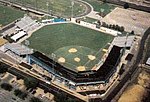
Tim McCarver Stadium

Tim McCarver Stadium was a stadium in Memphis, Tennessee. It was primarily used for baseball and was the home of the Memphis Blues (1968–1976), the Memphis Chicks (1978–1997), and the Memphis Redbirds (1998–1999). The ballpark had a capacity of 8,800 people and opened in 1963 as an American Legion field, dubbed Fairgrounds #3 due to its location at the former Mid-South Fairgrounds. Memphis Memorial Stadium, now Liberty Bowl Memorial Stadium, was constructed adjacent to it two years later. It was first used for professional baseball in 1968 and the Memphis Blues had the name changed to Blues Stadium. In October 1977, the new Memphis Chicks franchise changed the name of the ballpark to Tim McCarver Field after Tim McCarver, a Memphis native.It was unusual in that the infield in later years was AstroTurf so that Kansas City Royals players could practice on the artificial surface in preparation for playing at Kauffman Stadium which until 1995 was AstroTurf. The facility replaced Russwood Park, the previous baseball park, after its destruction by fire in 1960 which effectively sent Memphis baseball into dormancy for several years. Tim McCarver Stadium was in turn replaced by AutoZone Park in 2000. The ballpark's address was 800 Home Run Lane, a street which was east beyond right field and a parking lot. The other bordering streets were Raymond Skinner Drive (south, first base); Early Maxwell Boulevard (west, third base); playground and Central Avenue (north, left field). On July 12, 1993, the ballpark hosted the Double-A All-Star Game in which a team of National League-affiliated All-Stars defeated a team of American League-affiliated All-Stars, 12–7, before 6,335 people in attendance.The stands were demolished in 2005. The vacant lot is still visible in Google Maps as of 2019, with outlines of the former infield dirt and the outfield fence in evidence.