place

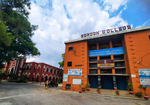
Government Christian Higher Secondary School, Rawalpindi

1856 establishments in British IndiaEducational institutions established in 1856Schools in Rawalpindi

Government Christian Higher Secondary School, previously known as Mission High School, Rawalpindi is a government school located in Raja Bazaar, Rawalpindi, Pakistan. It is one of the oldest school in Rawalpindi.

Excerpt from the Wikipedia article Government Christian Higher Secondary School, Rawalpindi (License: CC BY-SA 3.0, Authors).

Government Christian Higher Secondary School, Rawalpindi
Bazar Talwaran,

Geographical coordinates (GPS) Address Nearby Places
placeShow on map

Wikipedia: Government Christian Higher Secondary School, RawalpindiContinue reading on Wikipedia

Geographical coordinates (GPS)

Latitude Longitude
N 33.61326 ° E 73.05643 °
placeShow on map

Address

Mission High School

Bazar Talwaran
23451 , Gawalmandi
Punjab, Pakistan
mapOpen on Google Maps

Share experience

Nearby Places

Assassination of Benazir Bhutto

The assassination of Benazir Bhutto (Urdu: بینظیر بھُٹو کا قتل) took place on 27 December 2007 in Rawalpindi, Pakistan. Benazir Bhutto, twice Prime Minister of Pakistan (1988–1990; 1993–1996) and then-leader of the opposition Pakistan People's Party, which had been campaigning ahead of elections scheduled for January 2008. Shots were fired at Benazir Bhutto after a political rally at Liaqat National Bagh, and a suicide bomb was detonated immediately following the shooting. She was declared dead at 18:16 local time (13:16 UTC), at Rawalpindi General Hospital. Twenty-three other people were killed by the bombing. Bhutto had previously survived a similar attempt on her life (the 2007 Karsaz bombing) that killed at least 180 people, after her return from exile two months earlier. Following the tragic event, the Election Commission of Pakistan postponed the general elections by a month, which saw Bhutto's party win. Though early reports indicated that she had been hit by shrapnel or the gunshots, the Pakistani Interior Ministry initially stated that Bhutto died of a skull fracture sustained when the force of the explosion caused her head to strike the sunroof of the vehicle. Bhutto's aides rejected this version of the story, and argued instead that she suffered two gunshots before the bomb detonation. The Interior Ministry subsequently backtracked from its previous claim.In May 2007, Bhutto had asked for additional protection from foreign contracting agencies Blackwater and the British firm ArmorGroup. The United Nations' investigation of the incident stated that "Ms. Bhutto's assassination could have been prevented if adequate security measures had been taken."

Climate of Rawalpindi

Rawalpindi features a humid subtropical climate (Köppen: Cwa) with hot summers, and cool to cold winters. Its climate is classified as very similar to its twin city Islamabad, but the geographical location and extreme urbanization of Rawalpindi has led to weather and climatic conditions that are notably different from its twin. Rawalpindi's weather has historically been known to change rather quickly due to its proximity to Himalayas and the Pir Panjal Range. These mountains not only influence the weather of the city, but also provide great recreation during the hot months. Furthermore, Its warm comfortable mean annual temperature of 21.3 °C (70 °F) attracts people to live here permanently from all over Pakistan. The average annual rainfall is abundant at 1,346.8 millimetres (53.02 in), most of which falls in the monsoon season. However, frontal cloud bands also bring significant rainfall in the winter. In summers, June is the hottest with record maximum temperature at a blistering 48.3 °C (119 °F) recorded on 13 June 1953. On the other hand, January is the coldest month of the year when temperature can drop to a minimum −3.9 °C (25 °F) in the winter recorded on 17 January 1967. Throughout the year, Rawalpindi and Islamabad experience an average of about 98 thunderstorms, which is the highest frequency of thunderstorms in Punjab province of any plane station. In fact, most rainfall in the city is accompanied by a thunderstorm with peak activity experienced in August. Record rainfall was experienced in the year 2013 at a massive 1,988 millimetres (78.3 in) mostly due to an unusually wet monsoon season. On a typical day, the city hosts breezy afternoons (30 kilometres per hour (19 mph)+), but usually calm to light breeze (Beaufort scale) wind conditions are observed after midnight. The mean annual wind speed of Rawalpindi is roughly 10 kilometres per hour (6.2 mph) at 14 m height. Moreover, just a few kilometers southwest of Rawalpindi, the potential power generation has been identified by U.S. Aid to be between marginal to good (5.4 metres per second (19 km/h) to 7.4 metres per second (27 km/h)) at 50 m height.