place

Chapel of the Rosario, Puebla

1531 establishments in New Spain17th-century Roman Catholic church buildings in MexicoAzulejos in buildings in MexicoBaroque church buildings in PueblaChapels in Mexico
Dominican churches in MexicoHistoric centre of PueblaRoman Catholic churches completed in 1690Roman Catholic churches in Puebla (city)Tourist attractions in Puebla
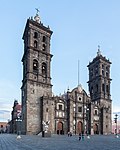
Capilla del Rosario Puebla Diciembre 2015

The Chapel of the Virgen del Rosario is the chapel attached to the Church of Santo Domingo in the city of Puebla, Puebla, Mexico. Work of the 17th century, summit of the New Spanish Baroque, was described in its time as the Eighth Wonder of the World by Friar Diego de Gorozpe, in a print of 1690, regarded like this for a long time in New Spain, as well as La Casa de Oro (The Golden House) and Domus Aurea. It is one of the most prominent examples of the New Spanish Baroque and one of the greatest artistic-religious achievements in Mexico. It is a chapel full of symbolisms, where each element represents something related to the Catholicism and Dominican Order beliefs. It is located on pedestrian avenue 5 de Mayo number 407. The building is part of the Historic Center of Puebla City, which was added to the UNESCO World Heritage List in 1987.

Excerpt from the Wikipedia article Chapel of the Rosario, Puebla (License: CC BY-SA 3.0, Authors, Images).

Chapel of the Rosario, Puebla
Privada Primera Cerrada de la 11 Sur, Puebla

Geographical coordinates (GPS) Address Nearby Places
placeShow on map

Wikipedia: Chapel of the Rosario, PueblaContinue reading on Wikipedia

Geographical coordinates (GPS)

Latitude Longitude
N 19.046527777778 ° E -98.198333333333 °
placeShow on map

Address

Centro Histórico de Puebla

Privada Primera Cerrada de la 11 Sur
72410 Puebla
Puebla, Mexico
mapOpen on Google Maps

Capilla del Rosario Puebla Diciembre 2015
Share experience

Nearby Places

Puebla Cathedral
Puebla Cathedral

The Basilica Cathedral of Puebla, as the Cathedral of Our Lady of the Immaculate Conception is known according to its Marian invocation, is the episcopal see of the Archdiocese of Puebla de los Ángeles (Mexico). It is one of the most important buildings in the historic center declared a World Heritage Site by UNESCO. It has the prerogative of being the first sumptuous temple that under good designs was made in the Americas, consecrated in 1649, ahead of the Metropolitan of Mexico that was dedicated in 1653. It was founded by Philip II of Spain.The current Herrerian-style cathedral was built between the 16th and 17th centuries, and replaced the previous one that existed in what is now the atrium. From the beginning of its construction in 1575 to its consecration, 74 years passed, which are located during the period of three kings of Spain, Philip II, Philip III and Philip IV. The setbacks throughout those years allowed numerous modifications to the original layout. By 1624 the works were completely suspended until the arrival of Bishop Juan de Palafox y Mendoza in July 1640, who resumed the works with determined enthusiasm. The new reforms gave a higher elevation to the central nave above the processional ones, allowing the passage of natural light and giving it the appearance of a pyramidal structure. It was consecrated by Bishop Juan de Palafox y Mendoza on April 18, 1649 without having been completely finished. The space it occupies is rectangular in shape, recharged in the corner of another larger floor, forming a large space for the atrium. The building is organized into five naves: a central one, two lateral ones and two niche chapels, its Renaissance-style façade stands out. Attached to its back is a building for offices of the Mitra, its former headquarters, and the building of the chapel called Ochavo. With its little more than 70 meters high, it was the tallest church in the Spanish colonies. The cathedral is considered one of the most important museums of New Spanish and later art due to the treasures it houses. Over the centuries it has been enriched in works of painting, sculpture, goldsmithing and carpentry of great artistic quality, as well as its decorations, the large boarded doors, iluminum and the treasures of the sacristy that protect the rich priestly ornaments embroidered with gold and silver thread, sacred vessels, chalices, ciboria, reliquaries and crosses bathed in gold inlaid with jewels and diamonds. Its historical archive has documents dating back to the founding of the city and many are waiting to be classified.