place

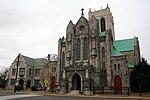
Le Bonheur Children's Hospital

Children's hospitals in the United StatesHospital buildings completed in 1952Hospitals established in 1952Hospitals in Memphis, TennesseePediatric trauma centers
Teaching hospitals in Tennessee
Le Bonheur Childrens Hospital 2010 09 12

Le Bonheur Children's Hospital is a 255-bed, tertiary care children's hospital located in Downtown Memphis, Tennessee. Le Bonheur has more than 700 medical staff representing 40 pediatric specialties. Approximately 170 patients per day are admitted, mostly from Tennessee and nearby states but also from around the world, mainly due to its nationally recognized brain tumor program, affiliation with St. Jude Children's Research Hospital and for being the home of the Children's Foundation Research Center. The hospital treats infants, children, teens, and young adults aged 0–21.Le Bonheur functions as the region's primary level 1 pediatric trauma center. The hospital cares for 14,000 patients every year, including about 81,000 visits to the emergency department a year and 8,800 surgeries per year. Le Bonheur also serves as a teaching hospital affiliated with the University of Tennessee Health Science Center and offers training in general pediatrics and pediatric subspecialties.

Excerpt from the Wikipedia article Le Bonheur Children's Hospital (License: CC BY-SA 3.0, Authors, Images).

Le Bonheur Children's Hospital
Adams Avenue, Memphis

Geographical coordinates (GPS) Address Phone number Website External links Nearby Places
placeShow on map

Wikipedia: Le Bonheur Children's HospitalContinue reading on Wikipedia

Geographical coordinates (GPS)

Latitude Longitude
N 35.144 ° E -90.0325 °
placeShow on map

Address

Le Bonheur Children's Hospital

Adams Avenue 848
38103 Memphis
Tennessee, United States
mapOpen on Google Maps

Phone number

call+19012875437

Website
lebonheur.org

linkVisit website

linkWikiData (Q6506577)
linkOpenStreetMap (496328350)

Le Bonheur Childrens Hospital 2010 09 12
Share experience

Nearby Places

James Lee House (690 Adams Avenue, Memphis)

The James Lee House, also known as the Harsson-Goyer-Lee House, is a historic house at 690 Adams Avenue in Memphis, Tennessee, United States. It is listed on the National Register of Historic Places, together with the adjacent Woodruff-Fontaine House. The two houses are included in the Victorian Village historic district. The 8,100-square-foot home was constructed by William Harsson in 1848. Harsson's daughter, Laura, married Charles Wesley Goyer, who bought the house in 1852. Goyer had it expanded by the architecture firm of Edward Culliatt Jones and Matthias H. Baldwin in 1871, after seeing their work in designing the neighboring Woodruff-Fontaine House. James Lee, a riverboat captain who had been educated at Princeton University, bought the house in 1890. In 1925 it became the James Lee Memorial Art Academy, a predecessor of the Memphis College of Art (formerly the Memphis Academy of Art). The city of Memphis took ownership in 1929. After the art school moved to a new location in 1959, the house was vacant for many years. It was used by Canadian indie rock group Tokyo Police Club in a music video for their 2008 song "In a Cave."In 2012 the empty house was purchased by new private owners. The following year, a $2 million construction and renovation project began, converting the house into a luxury bed and breakfast. The city of Memphis provided a property tax abatement to encourage its renovation. The bed and breakfast opened for business in April 2014.

University of Tennessee Health Science Center

The University of Tennessee Health Science Center (UTHSC) is a public medical school in Memphis, Tennessee. It includes the Colleges of Health Professions, Dentistry, Graduate Health Sciences, Medicine, Nursing, and Pharmacy. Since 1911, the University of Tennessee Health Science Center has educated nearly 57,000 health care professionals. As of 2010, U.S. News & World Report ranked the College of Pharmacy 17th among American pharmacy schools. Graduate medical education programs are located in Chattanooga, Knoxville, and Nashville; family medicine centers in Jackson, Knoxville, and Memphis; dentistry clinics in Bristol, Jackson, and Union City, as well as public and continuing education programs across the state. The Health Science Center is part of the statewide, multi-campus University of Tennessee system. The University of Tennessee Health Science Center also runs the Plough Center for Sterile Drug Delivery Systems, which celebrated its 53-year anniversary in 2016. The center educates on sterile product preparation, develops a basis for parenteral medications, and provides services to the pharmaceutical industry and individuals. Hands-on training in aseptic processing is also offered four times a year at the facility. Areas of emphasis are the university's research efforts, which receive nearly $100 million in yearly grants from the National Institutes of Health and private foundations. The Translational Science Research Building and the Cancer Research Building house collaborative research teams for the UTHSC campus. In its early years the school was segregated, and it desegregated in the early 1960s. The first black student, Alvin Crawford, graduated in 1964.

Russwood Park

Russwood Park was a stadium in Memphis, Tennessee. It was primarily used for baseball and was the home of the Memphis Chicks minor league baseball team until the spring of 1960. The ballpark was originally built in 1896 and was known as Elm Wood Park or Red Elm Park. In 1915, team owner Russell E. Garner incorporated his name into the ballpark's name. The "wood" part of the name would figure into its demise. Before its dramatic end, the ballpark was best known for being among the more uniquely shaped ballfields in the country. As with Nashville's Sulphur Dell, it was in a natural "bowl". The slopes were used as convenient foundations for seating areas. Constrained by its topography, a creek, and pre-existing buildings, the park was on an asymmetrical lot, with the deepest parts of left and right fields being significantly farther from home plate than the straightaway center. City directories gave its street address as 914 Madison Avenue. Its boundary streets included Madison (south, home plate), Dunlap Street (west, left field), and Jefferson Avenue beyond bordering buildings (north, center field). The creek (later covered to make a parking lot) ran outside the right field fence. The outfield dimensions following the 1921 remodeling were: left field 424 feet (129.2 m); center field 366 feet (111.6 m); and right field 301 feet (91.7 m), quickly angling out to a very deep right-center, about 425 feet (129.5 m). The left field distance was shortened somewhat by constructing an inner fence and bleachers. During construction of the foundations for a new stand on December 19, 1921, an unsupported trench caved in, resulting in injuries to six laborers and the death of 25-year-old Dace Smith.It was also the home field for the Memphis Tigers football team from 1912 to 1928, known as the West Tennessee State Normal School and the West Tennessee State Teachers College. One of its better-known non-baseball events was a concert by Memphis' adoptive son Elvis Presley on July 4, 1956. Coincidentally, 21 years later, Elvis would be pronounced dead at the Baptist Hospital across Madison Street to the south. The largest crowd attendance for wrestling in Memphis was set on August 17, 1959, at Russwood Park. The main event was Billy Wicks and Sputnik Monroe fighting in a no-contest for Monroe's Tennessee Championship. Attendance for the event has been reported to be between 17,000 and 18,000. The record would stand until the Monday Night Wars Era. The final event at the old ballpark was a pre-season exhibition game between the Chicago White Sox and the Cleveland Indians on Easter Sunday, April 17, 1960. A reported 7,279 fans watched the Indians beat the White Sox 2-1. The ballpark was a relic constructed primarily of wood except for steel supports for the roof. A fire of undetermined origin destroyed the ballpark that night after the game. The blaze threatened the Baptist Hospital across the street from it, and patients had to be evacuated. The Chicks played in several temporary facilities for the 1960 season, including a cramped high school football field a couple of blocks northeast of the ballpark site called Hodges Field, and then a city-owned field called Tobey Park. After the season, the club moved to Macon, Georgia. As it happens, the entire Southern Association disbanded after the 1961 season. A revived minor league entry for the city, called the Memphis Blues, began play in 1968 at Tim McCarver Stadium.