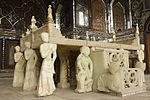
The Síyáh-Chál (Persian: سیاه چال literally "black pit") was a subterrenean dungeon southeast of the palace of the Sháh in Tehran. It carries a significant role in the history of the Baháʼí Faith, because its founder, Baháʼu'lláh was held there for four months in 1852, and it is where he claimed to have received a revelation. The Síyáh-Chál is regarded as the second holiest place in Iran to Baháʼís, after the house of the Báb, in Shiraz.
The pit was a discarded cistern converted into a dungeon. It had three flights of steep stairs descending into an area that received no light. There was no functioning latrine, and the small area was filled with up to 150 men.On 15 August 1852, a radical group of Bábís attempted the assassination of the Shah and failed. The group of Bábís linked with the plan were rounded up and executed, but notwithstanding the assassins' claim that they were working alone, the entire Bábí community was blamed, precipitating a pogrom against the Bábí community that was encouraged and orchestrated by the government. During this time many Bábís were killed, and about 30, including Baháʼu'lláh, were imprisoned in the Síyáh-Chál along with many criminals.According to Baháʼu'lláh, it was during this four-month imprisonment in appalling conditions that he had several mystical experiences, and received a vision of a maiden, through whom he received his mission as a messenger of God and as the one whose coming the Báb had prophesied. It was also the place where he composed his first known tablet, the Rashḥ-i-ʻAmá.
The ambassador of Russia requested that Baháʼu'lláh and others apparently unconnected with the conspiracy be spared. After he had been in the Síyáh-Chál for four months Baháʼu'lláh was in fact finally released, on condition he left Iran.
In 1868 the dungeon was filled-in and the Tikyíh Dowlat, an opera house, was built over the site. The site was Baháʼí property from 1954 until the Islamic Revolution of 1979.

 Continue reading on Wikipedia