place

Robert B. Ferguson Museum of Mineralogy

1918 establishments in ManitobaGeology museums in CanadaMuseums in WinnipegNatural history museums in CanadaUniversity museums in Canada

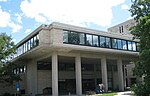
The Robert B. Ferguson Museum of Mineralogy is a museum in Winnipeg, Manitoba, Canada. It is located at the University of Manitoba in the Wallace Building. The museum got its start in 1918 by way of a donation from geologist Joseph Winthrop Spencer. His 1,100 mineral and rock specimen formed the basis of the early museum. The museum has grown over the years through various donations.Part of the collection is on display for the benefit of students. One sixth of the collection is displayed in the Wallace Building, and is arranged from the most chemically and structurally simple to progressively more complex.Many of the most attractive mineral specimens are on public display at the Ed Leith Cretaceous Menagerie.

Excerpt from the Wikipedia article Robert B. Ferguson Museum of Mineralogy (License: CC BY-SA 3.0, Authors).

Robert B. Ferguson Museum of Mineralogy
Dysart Road, Winnipeg

Geographical coordinates (GPS) Address Nearby Places
placeShow on map

Wikipedia: Robert B. Ferguson Museum of MineralogyContinue reading on Wikipedia

Geographical coordinates (GPS)

Latitude Longitude
N 49.8117 ° E -97.1358 °
placeShow on map

Address

Wallace Building

Dysart Road 125
R3T 2N2 Winnipeg
Manitoba, Canada
mapOpen on Google Maps

Share experience

Nearby Places

University of Manitoba

The University of Manitoba (U of M, UManitoba, or UM) is a Canadian public research university in the province of Manitoba. Founded in 1877, it is the first university of western Canada.Both by total student enrolment and campus area, the U of M is the largest university in the province of Manitoba and the 17th-largest in all of Canada. Its main campus is located in the Fort Garry neighbourhood of southern Winnipeg, with other campuses throughout the city. Along with the Fort Garry campus as its central hub, the University of Manitoba operates three other major locations: the Bannatyne Campus, the James W. Burns Executive Education Centre, and the William Norrie Centre. In addition, the university also administers its French-language affiliate, Université de Saint-Boniface in the Saint Boniface ward of Winnipeg. The university claims to maintain a reputation as a top research-intensive post-secondary educational institution, conducting more research annually than any other university in the region; its competitive academic and research programs have also consistently ranked among the top in the Canadian Prairies. Research at the University of Manitoba has accordingly produced various world-renowned contributions, including the creation of canola oil in the 1970s. Likewise, U of M alumni include Nobel Prize recipients, Academy Award winners, Order of Merit recipients, and Olympic medalists, among many others. As of 2019, there have been 99 Rhodes Scholarship recipients from the U of M, more than that of any other university in western Canada. Moreover, the university has produced countless government figures, including provincial premiers, Supreme Court justices, and Members of Parliament (MPs). The U of M is also a member of the U15 group of research-intensive universities in Canada and of Universities Canada, while its global affiliations include the International Association of Universities and the Association of Commonwealth Universities. The Manitoba Bisons represent the team in athletics as a member of U Sports and Canada West Universities Athletic Association (CWUAA).

Max Bell Centre (Winnipeg)

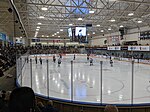
The Max Bell Centre is a multipurpose athletic facility located on the University of Manitoba campus in Winnipeg, Manitoba, Canada. It is located across the street from IG Field and next to the Investors Group Athletic Centre. Inside the complex is the Wayne Fleming Arena as well as the James Daly Fieldhouse, an indoor track and fieldhouse. The ice hockey arena is open year-round and has a seating capacity of 1,600. It is home to the Manitoba Bisons men's and women's hockey teams and was also used as a venue for inline hockey during the 1999 Pan American Games. The arena has also been host to the WHL team Winnipeg Ice since it relocated to Winnipeg in 2019. Prior to the start of the 2019-2020 Western Hockey League regular season, seating capacity at Wayne Fleming Arena was increased from 1,400 to 1,600, with a new balcony added on the east side of the arena. The balcony includes Premium Loge Seating which provide patrons with an excellent elevated view of the ice surface. In addition, a Fort Garry Brewing Co. Party Lounge beneath the loge provides a close-up view of the action at ice level. As part of that expansion, a new centre-hung scoreboard with video replay capabilities was added, as well as additional food and beverage kiosks. In 2021, a new energy-efficient ice plant was installed in the arena with funding from the Government of Canada and the University of Manitoba.The fieldhouse features two tracks and a large multipurpose infield. It has a seating capacity of 1,350 for track meets and other sporting events. The fieldhouse hosts the Manitoba Bisons track and field team. The complex is named after Canadian businessman and philanthropist Max Bell. The hockey arena portion of the complex is named in honour of the late Wayne Fleming. Fleming played for and coached the Bisons men's hockey team before moving onto a distinguished coaching career in professional hockey. The fieldhouse portion of the complex is named after the late James Morgan Cuthbert Daly who was a avid runner and coach in Winnipeg.

Centre for Ukrainian Canadian Studies

The Centre for Ukrainian Canadian Studies (CUCS) was founded in 1981, as a joint creation between the University of Manitoba and St. Andrew's College. The mission of the Centre is to create, preserve and communicate knowledge dealing with Ukrainian Canadian culture and scholarship. It is located in Winnipeg, Manitoba. The Centre for Ukrainian Canadian Studies, provides undergraduate courses and interdisciplinary programs of study in areas relating to Ukrainian Canadian culture. The Centre also encourages and promotes research and scholarship in all areas relating to Ukrainian Canadian Heritage Studies. The Centre offers nineteen courses in areas such as Ukrainian language, Ukrainian Canadian literature and folklore, the history of Ukraine and of the Ukrainians in Canada, the geography of Ukraine, the government and politics of Ukraine, Eastern Christianity, Byzantine art, and the Ukrainian arts in Canada. These courses can be taken singly, for general interest, as options, or as components of programs in various departments in the Faculty of Arts or in the School of Art. For students interested in specializing in the area, the Centre offers interdisciplinary programs in Ukrainian Canadian Heritage Studies leading to a Bachelor of Arts degree with a general major, an advanced major, or a minor in this field. The University of Manitoba is the only university in Canada which offers undergraduate degree programs in Ukrainian Canadian Heritage Studies. The Centre offers courses on the University of Manitoba campus, and at off-campus locations in Winnipeg. From time to time, the Centre is also able to offer courses at other locations in Manitoba and through teleconference, as well as specialized programs during the summer. Although the Centre does not offer graduate courses, it is possible to pursue graduate work in Ukrainian Canadian Heritage Studies at the M.A. and Ph.D. levels through Interdisciplinary Programs in the Faculty of Graduate Studies at the University of Manitoba. Several fellowships are available. Individual scholars are encouraged to pursue their own research agenda within a Ukrainian Canadian context. Topics of current interest include an exploration of Ukrainian Canadian history, the occurrence of Ukrainian Canadiana within North American popular culture, explorations of Ukrainian Canadian arts including folklore, fine arts, and literature, issues in genealogy, and the study of music both popular and classical) with a Ukrainian Canadian focus. An additional new direction is the development of an online courses on Ukrainian Canadian folklore. The Centre, since 2002, has held a bi-annual Tarnawecky Distinguished Lecture program at the University of Manitoba. This program is intended to bring academics and experts as speakers to the University. The current coordinator as of 2022 is Yuliia Ivaniuk.