place

Fort Street Historic District

Buildings and structures in Boise, IdahoIdaho Registered Historic Place stubsIdaho building and structure stubsNational Register of Historic Places in Ada County, Idaho
Carnegie Library (Boise, Idaho)

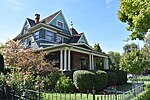
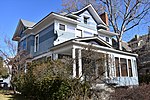
The Fort Street Historic District in Boise, Idaho, contains roughly 47 blocks located within the 1867 plat of Boise City. The irregular shape of the district is roughly bounded on the north by West Fort Street and on the south by West State Street. The west boundary is North 16th Street, and the east boundary is roughly North 5th Street. When the nomination form was prepared in 1982 for the National Register of Historic Places (NRHP), the district contained 318 buildings. The inventory consisted mostly of houses, but schools, churches, and commercial structures were included. Many structures were designed by Tourtellotte & Hummel, and some were designed by Wayland & Fennell. The district contains many sites with individual NRHP listing, and the Boise High School Campus and the St. John's Cathedral Block both are separately listed and contain multiple structures within the larger Fort Street Historic District. The district is itself contained within a larger area known locally as Boise's North End Preservation District, although the North End includes other NRHP listed historic districts.

Excerpt from the Wikipedia article Fort Street Historic District (License: CC BY-SA 3.0, Authors, Images).

Fort Street Historic District
West Hays Street, Boise North End

Geographical coordinates (GPS) Address Nearby Places
placeShow on map

Wikipedia: Fort Street Historic DistrictContinue reading on Wikipedia

Geographical coordinates (GPS)

Latitude Longitude
N 43.622222222222 ° E -116.2 °
placeShow on map

Address

West Hays Street 916
83702 Boise, North End
Idaho, United States
mapOpen on Google Maps

Carnegie Library (Boise, Idaho)
Share experience

Nearby Places

Minnie Priest Dunton House

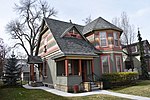
The Minnie Priest Dunton House was designed by John E. Tourtellotte and constructed in Boise, Idaho, United States, in 1899. The original Queen Anne design was that of a single family home, but the house was remodeled by Tourtellotte & Hummel in 1913 and became a seven-bedroom boardinghouse with Tudor Revival features. Dunton named her house "Rosemere" for her rose garden. It was included as a contributing property in the Fort Street Historic District on November 12, 1982. The house was individually listed on the National Register of Historic Places on November 17, 1982.Minnietta "Minnie" Priest Dunton was an early advocate of women's rights in Idaho, and she was appointed Idaho State Librarian in 1907. Her husband, Herbert W. Dunton, served as district attorney for Boise County, Idaho Territory, in the 1880s.The Minnie Priest Dunton House at its 1913 Country Reflects a Change and Transformation to Flats of a Queen Anne cottage Created by John Tourtellotte to Get Herbert Dunton in 1899. The initial arrangement is observable whilst the shiplapped, clip-cornered very first narrative of today's construction; stained-glass Queen Anne strip lights live at the top panel of the primary front doorways. Even the full stucco along with Halftimbered 2nd narrative, a stairhall to achieve this, a back inclusion featuring the operator's quarters, and also a bungaloid porch are the result of this 1913 remodelling. In its centre, the next narrative has a key hipped roof using a brief lateral seam. The roofline is further complicated with a counter forward over the authentic polygonal bay, and a gable on a second-story oriel bay, and also hipped and discard roofs across the left side oriel along with side and back ells. The front-facing gables of the roofing and also the little beginning porch possess a very low bungaloid pitch and also are encouraged on the flattened figure four mounts. Trimmed rafters are vulnerable under most lateral eaves. The gabled entrance porch in front is encouraged on blocky wooden articles using geometric decreased capitals. The reduced - est amount with this parapet wall, both notched with corner pedestals, goes round the front part of your home at the form of a patio wall. The arrangement, which looks like it'd have been meant to encourage that a continuation of this porch, looks precisely in this manner in the drawings to front altitude. In reality, but for the inclusion of an iron central railing in the cement stoop, your house looks completely obliterated out of the 1913 state.