place

South Kannanur

Cities and towns in Tiruchirappalli districtTiruchirapalli district geography stubsUse Indian English from October 2018

South Kannanur is a panchayat town in Tiruchirappalli district in the Indian state of Tamil Nadu.

Excerpt from the Wikipedia article South Kannanur (License: CC BY-SA 3.0, Authors).

Geographical coordinates (GPS)

Latitude Longitude
N 10.913055555556 ° E 78.741388888889 °
placeShow on map

Address


621112
Tamil Nadu, India
mapOpen on Google Maps

Share experience

Nearby Places

Uthamar Kovil
Uthamar Kovil

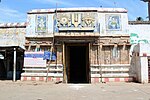
Uthamar Kovil (also known as Thirukkarambanoor or Bhikshandar Kovil) in Uthamarkoil, a village in the outskirts of Tiruchirappalli in the South Indian state of Tamil Nadu, is dedicated to the Hindu Trimurti of Vishnu, Shiva, and Brahma. Constructed in the Dravidian style of architecture, the temple is glorified in the Nalayira Divya Prabandham, the early medieval Tamil canon of the Alvar saints from the 6th–9th centuries CE. It is one of the 108 Divya Desams dedicated to Vishnu, who is worshipped as Purushothaman Perumal (also called as Purushothamar) and his consort Lakshmi as Poornavalli Thayar. Purushottamar is believed to have appeared to Hindu gods Brahma and Shiva, to relieve Shiva off his sins committed while cutting one of Brahma's heads. The temple is one of the few historical temples in India where the images of the Trimurti, Vishnu, Shiva and Brahma are housed in the same premises. It is one of the two temples in Chola Nadu where the trinity can be seen in the same premises, the other being Hara Saabha Vimocchana Perumal Temple at Thirukkandiyur. The temple is believed to have been built by the Medieval Cholas of the late 8th century CE, with later contributions from Vijayanagara kings and Madurai Nayaks. A granite wall surrounds the temple, enclosing all its shrines, while the temple tank is located outside the main gateway. Six daily rituals and four yearly festivals are held at the temple for each of trinities. The major festival of the temple, the Brahmotsavam, is celebrated during the Tamil month of Kartikai (November – December) when festival images of both Purushotamar and Bikshadanar are carried together in the streets surrounding the temple. The temple is maintained and administered by the Hindu Religious and Endowment Board of the Government of Tamil Nadu.

Sri Purushothaman Perumal Temple

Uthamar Kovil (also known as Thirukkarambanoor or Bhikshandar Kovil) in Uthamarkoil, a village in the outskirts of Tiruchirappalli in the South Indian state of Tamil Nadu, is dedicated to the Hindu Trimurti of Vishnu, Shiva, and Brahma. Constructed in the Dravidian style of architecture, the temple is glorified in the Nalayira Divya Prabandham, the early medieval Tamil canon of the Alvar saints from the 6th–9th centuries CE. It is one of the 108 Divya Desams dedicated to Vishnu, who is worshipped as Purushothaman Perumal (also called as Purushothamar) and his consort Lakshmi as Poornavalli Thayar. Purushottamar is believed to have appeared to Hindu gods Brahma and Shiva, to relieve Shiva off his sins committed while cutting one of Brahma's heads. The temple is one of the few historical temples in India where the images of the Trimurti, Vishnu, Shiva and Brahma are housed in the same premises. It is one of the two temples in Chola Nadu where the trinity can be seen in the same premises, the other being Hara Saabha Vimocchana Perumal Temple at Thirukkandiyur. The temple is believed to have been built by the Medieval Cholas of the late 8th century CE, with later contributions from Vijayanagara kings and Madurai Nayaks. A granite wall surrounds the temple, enclosing all its shrines, while the temple tank is located outside the main gateway. Six daily rituals and four yearly festivals are held at the temple for each of trinities. The major festival of the temple, the Brahmotsavam, is celebrated during the Tamil month of Kartikai (November – December) when festival images of both Purushotamar and Bikshadanar are carried together in the streets surrounding the temple. The temple is maintained and administered by the Hindu Religious and Endowment Board of the Government of Tamil Nadu.

Ranganathaswamy Temple, Srirangam

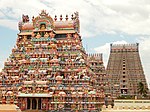
Sri Ranganathaswamy Temple is a Hindu temple dedicated to Ranganatha (a form of Vishnu), located in Srirangam, Tiruchirapalli, Tamil Nadu, India. Constructed in the Dravidian architectural style, the temple is glorified by Alvars in their Naalayira Divya Prabhandam and has the unique distinction of being the foremost among the 108 Divya Desams dedicated to the god Vishnu. It is the most illustrious Vaishnava temples in India. Beyond the ancient textual history, archaeological evidence such as inscriptions refer to this temple, and these stone inscriptions are from late 100 BCE to 100 CE., making it one of the "oldest surviving active temple complexes in South India". The Deity finds a mention in the great Sanskrit epic Ramayana which is dated around 800 to 400 BCE which also pushes the existence of deity to the same era, which shows that the temple is minimum 2500 to 3000 years old archeologically and traditionally 30 lakh years old. The temple has played an important role in Vaishnavism history starting with the 11th-century career of Ramanuja and his predecessors Nathamuni and Yamunacharya in Srirangam. Its location, on an island between the Kollidam and Kaveri rivers, has rendered it vulnerable to flooding as well as the rampaging of invading armies which repeatedly commandeered the site for military encampment. The temple was looted and destroyed by the Delhi Sultanate armies in a broad plunder raid on various cities of the Pandyan kingdom in early 14th century. The temple was rebuilt in late 14th century, the site fortified and expanded with many more gopurams in the 16th and 17th centuries. It was one of the hubs of early Bhakti movement with a devotional singing and dance tradition, but this tradition stopped during the 14th century and was revived in a limited way much later.The temple occupies an area of 63 hectares (155 acres) with 81 shrines, 21 towers, 39 pavilions, and many water tanks integrated into the complex making it the world's largest functioning Hindu temple. The temple town is a significant archaeological and epigraphical site, providing a historic window into the early and mid medieval South Indian society and culture. Numerous inscriptions suggest that this Hindu temple served not only as a spiritual center, but also a major economic and charitable institution that operated education and hospital facilities, ran a free kitchen, and financed regional infrastructure projects from the gifts and donations it received.The Srirangam temple is the largest temple compound in India and one of the largest religious complexes in the world. Some of these structures have been renovated, expanded and rebuilt over the centuries as a living temple. The latest addition is the outer tower that is approximately 73 metres (240 ft) tall, completed in 1987. Srirangam temple is often listed as the largest functioning Hindu temple in the world, the still larger Angkor Wat being the largest existing temple. The temple is an active Hindu house of worship and follows the Tenkalai tradition of Sri Vaishnavism. The annual 21-day festival conducted during the Tamil month of Margali (December–January) attracts 1 million visitors. The temple complex has been nominated as a UNESCO World Heritage Site, and is in UNESCO's tentative list. In 2017 the temple won the UNESCO Asia Pacific Award of Merit 2017 for cultural heritage conservation, making it the first temple in Tamil Nadu to receive the award from the UNESCO.