place

Old Greyhound Bus Station (Jackson, Mississippi)

1938 establishments in MississippiAfrican-American history of MississippiBus stations in MississippiBus stations on the National Register of Historic PlacesCivil rights movement
Civil rights protests in the United StatesGreyhound LinesHistoric district contributing properties in MississippiNational Register of Historic Places in Jackson, MississippiTransportation buildings and structures on the National Register of Historic Places in MississippiTransportation in Hinds County, Mississippi
Greyhound Bus Station, Jackson Mississippi 1939 12 22

The Greyhound Bus Station at 219 N. Lamar St., Jackson, Mississippi, was the site of many arrests during the May 1961 Freedom Rides of the Civil Rights Movement. The Art Deco building has been preserved and currently functions as an architect's office.

Excerpt from the Wikipedia article Old Greyhound Bus Station (Jackson, Mississippi) (License: CC BY-SA 3.0, Authors, Images).

Old Greyhound Bus Station (Jackson, Mississippi)
North Lamar Street, Jackson

Geographical coordinates (GPS) Address Nearby Places
placeShow on map

Wikipedia: Old Greyhound Bus Station (Jackson, Mississippi)Continue reading on Wikipedia

Geographical coordinates (GPS)

Latitude Longitude
N 32.301833333333 ° E -90.185611111111 °
placeShow on map

Address

North Lamar Street

North Lamar Street
39202 Jackson
Mississippi, United States
mapOpen on Google Maps

Greyhound Bus Station, Jackson Mississippi 1939 12 22
Share experience

Nearby Places

Sun-n-Sand Motor Hotel

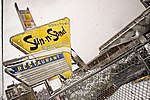
The Sun-n-Sand Motor Hotel was a motel in Jackson, Mississippi, United States. The motel was opened in 1960 and partially demolished in 2021. The motel was opened by Mississippi businessman Dumas Milner and was designed in either the International or mid-century modern style. Due to its close proximity to the Mississippi State Capitol, the motel served as the temporary lodging for many politicians and elected officials while the Mississippi Legislature was in session. Additionally, during the 1960s, it became a prominent lodging location for activists in the civil rights movement, such as Robert L. Carter of the NAACP and several members of the Council of Federated Organizations during the Freedom Summer project. In either 2001 or 2002, the motel closed. Following this, the government of Mississippi leased the property as a parking lot for government employees. In 2019, the government purchased the property and announced plans to demolish the building and convert the lot into additional parking spaces. This prompted outcry from many state historians and led to the motel being declared a Mississippi Landmark by the Mississippi Department of Archives and History and being added to the National Trust for Historic Preservation's list of America's Most Endangered Places in 2020. Despite this, much of the structure was demolished by February 2021, with only the sign and some of the commons areas preserved, with the intent of converting the latter into office and meeting spaces.