place

USS Des Moines (CA-134)

1946 shipsCold War cruisers of the United StatesDes Moines-class cruisersShips built in Quincy, Massachusetts
CA 134 Des Moines (19 NN CA 134 Des Moines 133136) DPLA 094e44882fa7c3fec3bef0d99c8535c5

USS Des Moines (CA-134) was the lead ship of the class of United States Navy heavy cruisers. She was the first ship in the United States Navy to feature the auto loading Mark 16 8-inch/55 caliber gun, the first of its type in the world. She was the second ship of the US Navy to be commissioned with the name of the capital of Iowa. Launched 1946, she was commissioned in 1948. She saw duty around the world until her decommissioning in 1961; she was permanently mothballed. A 1981 survey was done to determine if she was worthy of reactivation for the 600-ship Navy, but the cost was too great so she remained in the reserve. She was struck off the naval reserve in 1993, which was followed by a campaign to turn her into a museum ship. The campaign failed, and in 2005 she was sold for scrapping, and she was broken up by July 7. Parts of the ship have been donated to various places for display, including at the USS Salem museum, which is the only Des Moines-class ship to avoid the scrapyard.

Excerpt from the Wikipedia article USS Des Moines (CA-134) (License: CC BY-SA 3.0, Authors, Images).

USS Des Moines (CA-134)
Northwest 78th Avenue,

Geographical coordinates (GPS) Address Nearby Places
placeShow on map

Wikipedia: USS Des Moines (CA-134)Continue reading on Wikipedia

Geographical coordinates (GPS)

Latitude Longitude
N 41.7029543 ° E -93.7116003 °
placeShow on map

Address

Gold Star Museum

Northwest 78th Avenue
50131
Iowa, United States
mapOpen on Google Maps

CA 134 Des Moines (19 NN CA 134 Des Moines 133136) DPLA 094e44882fa7c3fec3bef0d99c8535c5
Share experience

Nearby Places

Saylorville Lake
Saylorville Lake

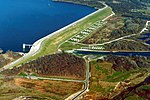
Saylorville Lake is a reservoir on the Des Moines River in Iowa, United States. It is located 11 miles (18 km) upstream from the city of Des Moines, and 214 miles (344 km) from the mouth of the Des Moines River at the Mississippi River. It was constructed as part of a flood control system for the Des Moines River as well as to aid in controlling flood crests on the Mississippi, of which the Des Moines is a tributary. The lake and dam is owned and operated by the U.S. Army Corps of Engineers, Rock Island District. At its normal level of 836 feet (255 m) above sea level, Saylorville Lake covers an area of 5,950 acres (24 km2) or 9.3 square miles (24.1 km2) and reaches some 17 miles (27 km) upstream. At full flood stage the lake can reach 16,700 acres (68 km2) or 26.1 square miles (67.6 km2) and reach 54 miles (87 km) long. At this point any further flow into the lake is channelled over an emergency spillway to the west of the main dam structure. The record high stage for the reservoir was 892.03 feet (271.89 m) above sea level set on July 11, 1993 during the Great Flood of 1993. Construction of the Saylorville Dam was authorized by Congress in 1958. Excavation began at the site in July 1965, becoming fully operational in September 1977. The dam itself is 6,750 feet (2,057 m) long, 105 feet (32 m) tall, and 44 feet (13 m) wide at the top. The lake is utilized for many recreational activities in the central Iowa area as well, as there is a large state park infrastructure surrounding the area of the lake, notably Jester Park and Big Creek State Park. The Corps of Engineers operates several recreation areas, campgrounds, and boat ramp facilities around the lake. Boating and swimming are very popular, as are camping, deer and game bird hunting, fishing, hiking, biking and disc golf. Coast Guard Auxiliary Flotilla 4 provides boating safety education and free vessel safety checks to boaters in the area. Fish species that can be found in the lake include crappie, bluegill, green sunfish, largemouth bass, smallmouth bass, brown trout, northern pike, common carp, white bass, walleye, yellow bass, american eel, flathead catfish, channel catfish, bullheads, and hybrid striped bass.