place

Belomorskaya (Moscow Metro)

Moscow Metro stationsRailway stations in Russia opened in 2018Zamoskvoretskaya Line
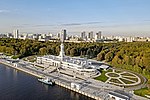
Moscow Belomorskaya metro station asv2019 06

Belomorskaya (Russian: Беломорская) is a station on the Zamoskvoretskaya line of the Moscow Metro. It was opened on 20 December 2018. It is located between Rechnoy Vokzal (south) and Khovrino (north). Belomorskaya was completed while the stretch between Rechnoy Vokzal and Khovrino was already in operation.

Excerpt from the Wikipedia article Belomorskaya (Moscow Metro) (License: CC BY-SA 3.0, Authors, Images).

Belomorskaya (Moscow Metro)
Беломорская улица, Moscow Levoberezhny District

Geographical coordinates (GPS) Address Nearby Places
placeShow on map

Wikipedia: Belomorskaya (Moscow Metro)Continue reading on Wikipedia

Geographical coordinates (GPS)

Latitude Longitude
N 55.865833 ° E 37.476388 °
placeShow on map

Address

Беломорская улица

Беломорская улица
125195 Moscow, Levoberezhny District
Moscow, Russia
mapOpen on Google Maps

Moscow Belomorskaya metro station asv2019 06
Share experience

Nearby Places

Businovo District
Businovo District

Businovo District (Russian: Буси́ново) was formerly a district in the north of Moscow, Russia. The village of Busino (Бусино) was first mentioned in the 16th century ; its name is derived from "Ivan Busa", the name of a local merchant in 1547, whose son was known as "Busin". The record books of 1584–1586 referred to the village as "Kokorevo (Кокорево), also known as Businovo". In 1685, the village was a part of the lands owned by the Novodevichy Convent. In 1912, the village comprised 75 households. In 1960, the community it was completely absorbed by Moscow and turned into a typical late Soviet sleeping district. In 1991, as a result of Moscow's administrative reform, Businovo District was established. Located close to the MKAD, Businovo was one of the northernmost districts of Moscow. It bordered Khovrino District in the west and Khimki in the north. Its area was approximately 2.8 square kilometers (1.1 sq mi). It had only three streets that circled it. There were two schools, two kindergartens, a music school, a municipal library, a polyclinic, and a militsiya station in the district. The closest metro station was Rechnoy Vokzal. The district existed until August 22, 1997, when its territory was formally merged into Zapadnoye Degunino District. Cogeneration plant (TETs-21) located on the eastern edge of Businovo is the largest in Europe in terms of generated heat with an estimated power 4,958 Gcal/h.

Hovrinskaya Hospital

Hovrinskaya hospital (Russian: Ховринская больница; HZB, Hovrinka, Umbrella, Unfinished) was an abandoned building in the Hovrino District of Moscow in the Hovrino area, near the railway station of the same name. The building had a design which was also common to many others found within the Soviet Union. The hospital was designed to resemble the shape of a star, with branching corridors at the end of each point. The three wings of the building came together at a central point to form three courtyards with porches. Placed adjacent to the main building was an annex which housed the pathology department. Due to the unfinished construction, parts of the building only contained fragments of walls and floors, with the basement was also prone to flooding. Explanations for the abandonment of construction range from a lack of funding to possible shortcomings which emerged in the project and lead to its abandonment. According to a map of Moscow from 1952, the hospital was to be built by the river Likhoborka and surrounding wetlands with sewage treatment facilities located nearby. The abandoned building was well known among fans of urban legends as one of the most mysterious places in Moscow. Among urban explorers, the hospital earned the name "The Umbrella"' due to its resemblance to the logo of the Umbrella Corporation from the video game and film series Resident Evil and its similarity to the biohazard symbol.It is the title-place of one of the chapters of the book I Love Russia: Reporting from a Lost Country by Elena Kostyuchenko, in which many of its inhabitants and stories are portrayed.