place

Bernhöftstorfan

Buildings and structures in Reykjavík

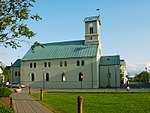
Bernhöftstorfan is a row of houses in central Reykjavík that faces Lækjargata in one direction and Skólastræti in another. The oldest houses in the row were built in 1834.The row of houses was controversial in the history of urban planning in Reykjavík, as there heated disputes in the 1970s as to whether the row should be demolished or protected and restored. The row of houses was given heritage preservation status in 1979.

Excerpt from the Wikipedia article Bernhöftstorfan (License: CC BY-SA 3.0, Authors).

Bernhöftstorfan
Lækjargata, Reykjavik Miðborg

Geographical coordinates (GPS) Address Nearby Places
placeShow on map

Wikipedia: BernhöftstorfanContinue reading on Wikipedia

Geographical coordinates (GPS)

Latitude Longitude
N 64.1468 ° E -21.9362 °
placeShow on map

Address

Lækjargata 3a
101 Reykjavik, Miðborg
Iceland
mapOpen on Google Maps

Share experience

Nearby Places

Menntaskólinn í Reykjavík

Menntaskólinn í Reykjavík (MR; official name in English: Reykjavik Junior College) is a junior college in Iceland. It is located in Reykjavík. The school traces its origin to 1056, when a school was established in Skálholt, and it remains one of the oldest institutions in Iceland. The school was moved to Reykjavík in 1786, but poor housing conditions forced it to move again in 1805 to Bessastaðir near Reykjavík. In 1846 the school was moved to its current location, and a new building was erected for it in Reykjavík. This was the largest building in the country at the time and can be seen on the 500 Icelandic krona bill. It was used initially when Althing began to meet again in Reykjavík after a few years hiatus and thus it is in this building where Icelandic independence leader Jón Sigurðsson led the MPs in their famous phrase, Vér mótmælum allir. The school has previously been known as Lærði skólinn (The Learned School), Latínuskólinn (The Latin School) and by the Latin title Schola Reykjavicensis; it received its present name in 1937. Menntaskólinn í Reykjavík offers a three-year course of study. It usually ends with a degree (stúdentspróf) which gives the graduating student the right to advance to an Icelandic university. Many Icelandic politicians, including the first prime minister Hannes Hafstein, former Prime Minister Davíð Oddsson, former President of Iceland, Ólafur Ragnar Grímsson and current president, Guðni Th. Jóhannesson all attended MR. Almost every Prime Minister of Iceland has been educated at the school apart from Halldór Ásgrímsson, Ólafur Jóhannesson, Sigurður Ingi Jóhannsson, Þorsteinn Pálsson and Katrín Jakobsdóttir. Geir H. Haarde, Davíð's successor as chairman of the Independence Party and former Prime Minister, also took over from him as chairman of student body, Skólafélagið (inspector scholae). In 1879 Hannes Hafstein was the school's first inspector scholae, and in 1940 his grandson Einar Ragnarsson Kvaran achieved the position. The former President of Iceland, Ólafur Ragnar Grímsson, was also the president of the main student body, Framtíðin.

Icelandic Phallological Museum

The Icelandic Phallological Museum (Icelandic: Hið íslenzka reðasafn [ˈhɪːð ˈistlɛnska ˈrɛːðaˌsapn̥]), located in Reykjavík, Iceland, houses the world's largest display of penises and penile parts. As of early 2020 the museum moved to a new location in Hafnartorg, three times the size of the previous one, and the collection holds well over 300 penises from more than 100 species of mammal. Also the museum holds 22 penises from creatures and peoples of Icelandic folklore. In July 2011, the museum obtained its first human penis, one of many promised by would-be donors. Its detachment from the donor's body did not go according to plan and it was reduced to a greyish-brown shriveled mass that was pickled in a jar of formalin. The museum continues to search for "a younger and a bigger and better one."Founded in 1997 by since-then retired teacher Sigurður Hjartarson and now run by his son Hjörtur Gísli Sigurðsson, the museum grew out of an interest in penises that began during Sigurður's childhood when he was given a cattle whip made from a bull's penis. He obtained the organs of Icelandic animals from sources around the country, with acquisitions ranging from the 170 cm (67 in) front tip of a blue whale penis to the 2 mm (0.08 in) baculum of a hamster, which can only be seen with a magnifying glass. The museum claims that its collection includes the penises of elves and trolls, though, as Icelandic folklore portrays such creatures as being invisible, they cannot be seen. The collection also features phallic art and crafts such as lampshades made from the scrotums of bulls. The museum has become a popular tourist attraction with thousands of visitors a year and has received international media attention, including a Canadian documentary film called The Final Member, which covers the museum's quest to obtain a human penis. According to its mission statement, the museum aims to enable "individuals to undertake serious study into the field of phallology in an organized, scientific fashion."