place

Austurvöllur

Geography of ReykjavíkTourist attractions in Reykjavík
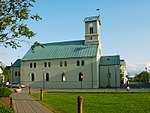
Church on Austurvollur Square (53952964)

Austurvöllur (Icelandic pronunciation: ​[ˈœistʏrˌvœtlʏr̥]) is a public square in Reykjavík, Iceland. The square is a popular gathering place for the citizens of Reykjavík, and especially during good weather due to the prevalence of cafés on Vallarstræti and Pósthússtræti. It has also been a focal point of protests due to the close location to the Parliament of Iceland. The square contains a large statue of Jón Sigurðsson, a leader of Iceland's independence movement. Austurvöllur is surrounded by Vallarstræti, Pósthússtræti, Kirkjustræti and Thorvaldsensstræti. The latter of which is named after Bertel Thorvaldsen, a statue of whom was, for a long period of time, present in the centre of Austurvöllur, now occupied by a statue of Jón Sigurðsson. Located around the perimeter of the square are: the Alþingishúsið (Parliament House), the Dómkirkjan (the city's oldest church), the Hotel Borg, as well as numerous cafés, restaurants and bars. In the early 18th century, Austurvöllur was much larger and stretched from Aðalstræti in the west towards the creek in the east, and Aðalstræti in the north towards Tjörn in the south.

Excerpt from the Wikipedia article Austurvöllur (License: CC BY-SA 3.0, Authors, Images).

Austurvöllur
Reykjavik Miðborg

Geographical coordinates (GPS) Address Nearby Places
placeShow on map

Wikipedia: AusturvöllurContinue reading on Wikipedia

Geographical coordinates (GPS)

Latitude Longitude
N 64.1472 ° E -21.9398 °
placeShow on map

Address


Reykjavik, Miðborg
Iceland
mapOpen on Google Maps

Church on Austurvollur Square (53952964)
Share experience

Nearby Places

Althing
Althing

The Alþingi (general meeting in Icelandic, [ˈalˌθiɲcɪ], anglicised as Althingi or Althing) is the supreme national parliament of Iceland. It is one of the oldest surviving parliaments in the world. The Althing was founded in 930 at Þingvellir ("thing fields" or "assembly fields"), situated approximately 45 kilometres (28 mi) east of what later became the country's capital, Reykjavík. Even after Iceland's union with Norway in 1262, the Althing still held its sessions at Þingvellir until 1800, when it was discontinued. It was restored in 1844 by royal decree and moved to Reykjavík. The restored unicameral legislature first came together in 1845 and after 1874 operated in two chambers with an additional third chamber taking on a greater role as the decades passed until 1991 when Althing became once again unicameral. The present parliament building, the Alþingishús, was built in 1881, made of hewn Icelandic stone. The unicameral parliament has 63 members, and is elected every four years based on party-list proportional representation. The current speaker of the Althing is Birgir Ármannsson. The constitution of Iceland provides for six electoral constituencies with the possibility of an increase to seven. The constituency boundaries and the number of seats allocated to each constituency are fixed by legislation. No constituency can be represented by fewer than six seats. Furthermore, each party with more than 5% of the national vote is allocated seats based on its proportion of the national vote in order that the number of members in parliament for each political party should be more or less proportional to its overall electoral support. If the number of voters represented by each member of the Althing in one constituency would be less than half of the comparable ratio in another constituency, the Icelandic National Electoral Commission is tasked with altering the allocation of seats to reduce that difference.

Alþingishúsið
Alþingishúsið

Alþingishúsið (Icelandic pronunciation: ​[ˈalˌθiɲcɪsˌhuːsɪθ], The Parliament House) is a classical 19th century structure which stands by Austurvöllur in central Reykjavík, Iceland. It houses Alþingi, the Icelandic parliament. The building was designed by Danish architect Ferdinand Meldahl and built using hewn dolerite from 1880 to 1881. The reliefs on the tympanums of the four outermost windows on the first floor represent the four Landvættir of Iceland: a dragon, a vulture, a giant and a bull, momentarily appeased by Ingólfur Arnarson when he first landed in Iceland. Alþingishúsið has also housed the Icelandic National Library and Antiquaries Collection, and later the Icelandic National Gallery. The University of Iceland used the first floor of the house from 1911 to 1940, and the President of Iceland had his offices in the building until 1973. Today, only the debating chamber, a few small meeting rooms and the offices of some of the senior parliamentary staff are actually located in Alþingishúsið. Committee meeting rooms, parliamentarians’ offices and most of Alþingi's secretariat are located in other buildings in the area around Austurvöllur. There are currently plans to build a new building to house these offices and meeting rooms in the area immediately to the west of Alþingishúsið, where there is today a parking lot and a few smaller buildings currently being used by Alþingi and which will be incorporated into the new building.

Ministry of Communications (Iceland)

The Icelandic Ministry of Communications (Icelandic: Samgönguráðuneytið) was a cabinet-level ministry responsible for transport by land, sea and air, as well as telecommunications and postal services. Since September 2010, the minister had been Ögmundur Jónasson of the Left-Green Movement. Various organisational changes has taken effect in the Ministry of Transport, Communications and Municipal Affairs. A number of projects have been transferred to the Ministry, which has expanded its staff by 8 employees to a total of 36. The work of the Ministry covered i.a. the preparation of drafts of legislative proposals for parliamentary purposes, drafting of regulations, issue of work permits and professional licences, publication of reports and information dissemination. International co-operation is also an important feature of Ministry operations. Under the auspices of the Ministry were: The Public Road Administration (Vegagerðin), the Road Accident Analysis Group, the Icelandic Maritime Administration, the Icelandic Civil Aviation Administration, Marine Accident Investigation Board, Aircraft Accident Investigation Board, the Post and Telecom Administration, Equalization Fund, and Keflavik Airport Ltd. The Ministry was divided into four departments: The Department of Administrative and Financial Affairs The Department of Communications The Department of Municipalities and Equalization Fund The Department of TransportationIn 2011, the Ministry was merged with the Ministry of Justice and Human Rights to form the Ministry of Interior.