place

Abbey of Notre Dame aux Nonnains

Benedictine monasteries in FranceNunneries in FranceRoman Catholic churches in Troyes
Abbaye de Notre Dame aux Nonnains

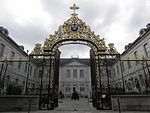
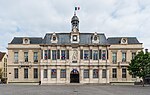
The Abbey of Notre Dame aux Nonnains (French: Abbaye de Notre-Dame-aux-Nonnains: Abbey of Our Lady of the Nuns), also called the Royal Abbey of Our Lady of Troyes (French: Abbaye royale de Notre-Dame de Troyes), was a convent founded before the 7th century in Troyes, France. The non-cloistered canonesses became wealthy and powerful in the Middle Ages. In 1266–68 they defied the pope and used force to delay construction of the collegiate Church of St Urbain. They were excommunicated as a result. Later the abbey adopted a strictly cloistered rule and the nuns became impoverished. Work started on building a new convent in 1778 but was only partially completed before the French Revolution (1789–99). The abbey was closed in 1792 and the church was demolished. The convent became the seat of the prefecture of Aube.

Excerpt from the Wikipedia article Abbey of Notre Dame aux Nonnains (License: CC BY-SA 3.0, Authors, Images).

Abbey of Notre Dame aux Nonnains
Rue Pierre Labonde, Troyes

Geographical coordinates (GPS) Address Nearby Places
placeShow on map

Wikipedia: Abbey of Notre Dame aux NonnainsContinue reading on Wikipedia

Geographical coordinates (GPS)

Latitude Longitude
N 48.297337 ° E 4.078266 °
placeShow on map

Address

Préfecture de l'Aube Et Hôtel de Département

Rue Pierre Labonde
10000 Troyes
Grand Est, France
mapOpen on Google Maps

Abbaye de Notre Dame aux Nonnains
Share experience

Nearby Places

Troyes
Troyes

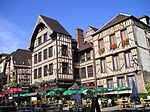
Troyes (French pronunciation: [tʁwa] ) is a commune and the capital of the department of Aube in the Grand Est region of north-central France. It is located on the Seine river about 140 km (87 mi) south-east of Paris. Troyes is situated within the Champagne wine region and is near to the Orient Forest Regional Natural Park. Troyes had a population of 61,996 inhabitants in 2018. It is the center of the Communauté d'agglomération Troyes Champagne Métropole, which was home to 170,145 inhabitants. Troyes developed as early as the Roman era, when it was known as Augustobona Tricassium. It stood at the hub of numerous highways, primarily the Via Agrippa. The city has a rich historical past, from the Tricasses tribe to the liberation of the city on 25 August 1944 during the Second World War, including the Battle of the Catalaunian Plains, the Council of Troyes, the marriage of Henry V and Catherine of France, and the Champagne fairs to which merchants came from all over Christendom. The city has a rich architectural and urban heritage: many buildings are protected as historical monuments, including the half-timbered houses (mainly of the 16th century) that survived in the old town. They have contributed to Troyes being designated as a City of Art and History. Manufacturing of textiles, developed from the 18th century onwards, was a chief part of Troyes' economy until the 1960s. Today, Troyes is the European capital of factory outlets and trading, and has three brand centers.

Roman Catholic Diocese of Troyes

The Diocese of Troyes (Latin: Dioecesis Trecensis; French: Diocèse de Troyes) is a Latin Church ecclesiastical territory or diocese of the Catholic Church in Troyes, France. The diocese now comprises the département of Aube. Erected in the 4th century, the diocese is currently a suffragan diocese in the ecclesiastical province of the metropolitan Archdiocese of Reims. It was re-established in 1802 as a suffragan of the Archbishopric of Paris, when it comprised the départements of Aube and Yonne and its bishop had the titles of Troyes, Auxerre, and Châlons-sur-Marne. In 1822, the See of Châlons was created and the Bishop of Troyes lost that title. When Sens was made an archdiocese, the episcopal title of Auxerre went to it and Troyes lost also the département of Yonne, which became the Archdiocese of Sens. The Diocese of Troyes covers, besides the ancient diocesan limits, 116 parishes of the ancient Diocese of Langres and 20 belonging to the ancient diocese of Sens. On 8 December 2002, the Diocese of Troyes was returned to its ancient metropolitan, the Archbishop of Reims. As of 2014, there was one priest for every 2,710 Catholics. When Troyes was the seat of the Bishop as well as of the Comte de Champagne, there was always tension between the two in terms of power and influence. After 1314, when Louis de Navarre became King Louis X of France, the competition was more distant but the competitor far more powerful. The Capitular Church of Saint-Étienne became a royal church, and the King tolerated no interference from the Bishop in his prerogatives.

Abbey of Saint Loup, Troyes

The Abbey of Saint-Loup (French: Abbaye Saint-Loup de Troyes) is a religious building near Troyes in Champagne, France. It was established in the ninth century to shelter the relics of bishop Lupus of Troyes, Saint Loup, the legendary defender of the city against Attila in the 5th century and patron of the city. The monastic community was reformed in 1135 by Bernard of Clairvaux, when the abbot and his monks embraced the Rule of Saint Augustine and became Canons Regular. The Abbaye Saint-Loup, which came to be enclosed within the burgeoning medieval city of Troyes, developed a renowned library and scriptorium. The famous poet Chrétien de Troyes may have been a canon of this monastic house.The abbey was founded — as were many abbeys— in an existing Gallo-Roman villa abutting the former Roman Via Agrippa (now the rue de la Cité) just outside the former Gallo-Roman city. Charlemagne gave the abbey of Saint-Loup to the scholarly Alcuin, and Adalelm, Count of Troyes (died 894) was a patron. Before the reform of 1135 Saint-Loup's secular canons could enjoy the fruits of their prebendaries. In the fifteenth century an imposing Flamboyant Gothic abbey church was erected; the abbey church was rededicated in 1425. The scholarly Petrus Comestor was an Augustinian canon of Saint-Loup, among his other benefices.The abbey's church and buildings, largely reconstructed in the seventeenth century, were destroyed during the Revolution; the only building left standing, in rue Chrestien de Troyes, was used to store books and manuscripts confiscated from neighbouring abbeys and convents, among which was the Abbey of Clairvaux. Thus a municipal public library in Troyes was first created. The Musée Saint Loup (Musée des Beaux-Arts, Archéologie et Histoire Naturelle) was also installed in the building, where it has remained since 1830.