place

Scuola Italiana Arturo Dell' Oro

Chilean school stubsItalian international schools in ChileItalian school stubsValparaísoValparaíso Region
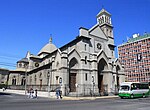
Scuola Italiana Arturo Dell' Oro, Valparaíso

Scuola Italiana Arturo Dell' Oro is a private Italian international school with campuses in Valparaíso and Viña del Mar in Chile. It serves this city and Vina del Mar and has scuola infanzia (preschool) through secondaria II grado (upper secondary school). The Viña del Mar is located in the Miraflores neighborhood.The Società Italiana d'Istruzione was established on 12 October 1912. It acquired land at Av. Yerbas Buenas to establish a permanent Italian school. 128 students attended its first classes in 1933. It moved to unfinished facilities in Av. Pedro Montt in 1941. The Viña del Mar school opened in 2003.

Excerpt from the Wikipedia article Scuola Italiana Arturo Dell' Oro (License: CC BY-SA 3.0, Authors, Images).

Scuola Italiana Arturo Dell' Oro
Avenida Pedro Montt, Valparaíso Almendral

Geographical coordinates (GPS) Address Website External links Nearby Places
placeShow on map

Wikipedia: Scuola Italiana Arturo Dell' OroContinue reading on Wikipedia

Geographical coordinates (GPS)

Latitude Longitude
N -33.047 ° E -71.6105 °
placeShow on map

Address

Scuola Italiana Arturo Dell'Oro

Avenida Pedro Montt 2447
2362834 Valparaíso, Almendral
Valparaiso Region, Chile
mapOpen on Google Maps

Website
scuolaitalianavalpo.cl

linkVisit website

linkWikiData (Q6122665)
linkOpenStreetMap (313491847)

Scuola Italiana Arturo Dell' Oro, Valparaíso
Share experience

Nearby Places

Pontifical Catholic University of Valparaíso

The Pontifical Catholic University of Valparaiso (Spanish: Pontificia Universidad Católica de Valparaíso) (PUCV), also known as Universidad Católica de Valparaíso (UCV), is one of six Catholic universities in Chile and one of the two pontifical universities in the country, along with the Pontifical Catholic University of Chile. Founded in 1928, it is located in Valparaíso Region and has about 18,000 students.It is recognized in Chile as an institution with high academic prestige and as a research university due to its acquired research funds and offered postgraduate degrees in the fields of science, engineering, humanities and arts. As a Catholic university, it answers directly to the Holy See and the Bishopric of Valparaíso. The PUCV is a traditional university and one of the twenty-five institutions within the Chilean Rectors' Council (Consejo de Rectores). Although it is not state-owned, a substantial part of its budget is given by state transfers under different programs. PUCV is an urban university. It has a central campus known as Casa Central (Central House) located in downtown Valparaíso, only a few blocks away from the Chilean Congress, the Metro, and the Pacific Ocean. One of the drawbacks of being an urban university is the difficulty of growing at the original site of its foundation, close to the city center. Hence, while some PUCV buildings are on the historic palm-tree-lined Avenida Brasil, severl of its schools are dispersed throughout Valparaíso, Viña del Mar, Quilpué and Quillota. At the 2019 edition of the América Economía magazine university ranking, the university was positioned 4th nationwide and the QS Latin America University Ranking of 2023 has placed it 22nd out of 428 qualifying institutions (and 5th nationwide). The university is accredited for seven years, the maximum number of years awarded by the National Accreditation Commission, for the period between 2021 and 2028. The PUCV, the University of Chile, the Catholic University, the University of Santiago and the University of Concepción are the only institutions in Chile that have received the highest number of years in accreditation. PUCV attracts students from different regions of Chile, as well as hundreds of exchange students from Europe, North America and several countries from South America, due to its student exchange programs.

Trolleybuses in Valparaíso

Trolleybuses in Valparaíso, Chile, have provided a portion of the public transit service since 1952. The trolleybus system is the second-oldest in South America. The originally state-owned system has been privately owned since 1982, and since 1994 it has been Chile's only operational trolleybus system. Almost half of its vehicles were built in 1946–52 by the Pullman-Standard Company, and they are the oldest trolleybuses in regular service anywhere in the world. Those vehicles were collectively declared a national monument by the Chilean government in 2003. They helped the city gain its designation by UNESCO as a World Heritage Site, and have been called "a heritage sight in their own right" by at least one travel writer.In 1991–1992 the system acquired several secondhand trolleybuses from four Swiss cities. Even these vehicles, already old at the time of acquisition, became historic in their continued service after some 45–50 years or more, with 1959-built ex-Zürich number 105 being the oldest articulated trolleybus of any make still in service on any trolleybus system worldwide for almost 20 years until its retirement in May 2015. In the late 2010s, a new group of secondhand Swiss trolleybuses, 18 1989-built NAWs from the Lucerne trolleybus system, replaced all of the older Swiss vehicles, and now make up more than half of the fleet, with vintage Pullman-Standard trolleybuses continuing to make up the remainder.The Valparaíso trolleybus system has become one of the icons of the city, considered an important part of its cultural heritage. Many porteños – as residents of this port city commonly call themselves – are fond of their city's distinctive and historic trolleybus service and have spoken up in its defense when the system has come under threat of closure. The private operating company receives no government subsidy, and at times it has struggled financially, putting the system in danger of being closed. One such occasion, the company's announcement in May 2007 of imminent closure plans, brought an outcry from local citizens, and even Chile's president, Michelle Bachelet, expressed support for keeping the trolleybuses going.Trolleybuses currently serve two routes, numbered 801 and 802 in a regional transportation plan implemented in 2007, Monday through Saturday, from about 7 a.m. to 10 p.m. There is no service on Sundays. Both routes connect Barón with Aduana, 801 via Avenida Pedro Montt, 802 via Avenida Colón and each is about 5 km (3 mi) long. The system is currently owned and operated by Trolebuses de Chile, S.A. Locally, the vehicles are often referred to as troles (trolleys), as opposed to trolebuses.

University of Valparaíso

The University of Valparaíso (UV) is a state public university in Chile, with its headquarters and the majority of its campuses in the city of Valparaíso. It has several other campuses in the Valparaiso Region of Chile (Quinta Región) and in Santiago, which is 100 km from Valparaiso. Taking its current name as an autonomous university on February 12, 1981, UV is heir to the most longstanding higher education tradition in Valparaiso and its region. As the major Pacific port south of San Francisco, Valparaiso was an important centre of business in the nineteenth century. Formal studies in law began there in 1878. By 1911, teaching had evolved into Chile’s first regional School of Law, part of the national University of Chile (UCH, which in turn can trace its origins back through two colonial universities to 1622, some 82 years after the Spanish began their colonisation of today’s central Chile). Two private universities would form in Valparaiso in the 1920s and 1930s—what would become Universidad Técnica Federico Santa María (UTFSM, or USM) and Pontificia Universidad Católica de Valparaíso (PUCV, or UCV)—as state-backed higher education was also consolidated under the aegis of the national Universidad de Chile system. In 1972, public university education in Valparaiso was organized as a Seat (Sede) of UCH; UV inherited all of this except for the Teaching Institute, which would eventually become the basis of the Universidad de Playa Ancha. On February 12, 1981 the University of Valparaiso adopted its present name and autonomous form. The creation of public regional universities was an important component of the economic reforms undertaken under the military rule that lasted until 1990. UV is one of sixteen members of the Consortium of State Universities of Chile. All of these took their more or less current structure following a decision to divide the Universidad de Chile and the State Technical University into autonomous entities. UV and all state universities are among the 25 members of Chile’s Council of University Rectors (“CRUCH”); these 25 are often referred to as the “traditional” universities, as opposed to the other “new private” universities. UV is also in the Grouping of Regional Universities of Chile, all of whose members are public and have been discussed (in English) together as public regional universities.Higher education contributing much to its economy, Valparaiso is Chile's "college town". Three other traditional universities are based in Valparaiso – UTFSM, PUCV and "Universidad de Playa Ancha" (UPLA) – all of these are organized more in a “campus” style than UV, although Católica has departments strewn throughout the city and branch campuses in the region. UV’s various faculties and schools form a university quarter the length of the plain (plano') 'of central Valparaiso, between the main UPLA campus in the south and in the north the main PUVC building. Since January 2021 the rector of the university has been Osvaldo Corrales.

Valparaíso
Valparaíso

Valparaíso (Spanish: [balpaɾaˈiso]) is a major city, commune, seaport and naval base in the Valparaíso Region, Chile. "Greater Valparaíso" is the second largest metropolitan area in the country. Despite only being the second largest city in the metropolitan area of Greater Valparaíso, with the first being Viña del Mar, Valparaíso serves as the namesake for the region due to its historical and cultural significance. Valparaíso is located about 120 km (75 mi) northwest of Santiago by road and is one of the Pacific Ocean's most important seaports. Valparaíso is the capital of Chile's second most populated administrative region and has been the headquarters for the Chilean Navy since 1817 and the seat of the Chilean National Congress since 1990. Valparaíso played an important geopolitical role in the second half of the 19th century when it served as a major stopover for ships traveling between the Atlantic and Pacific oceans by crossing the Straits of Magellan. Valparaíso experienced rapid growth during its golden age, as a magnet for European immigrants, when the city was known by international sailors as "Little San Francisco" and "The Jewel of the Pacific". Notable inheritances from its golden age include Latin America's oldest stock exchange, the continent's first volunteer fire department, Chile's first public library, and the oldest Spanish language newspaper in continuous publication in the world, El Mercurio de Valparaíso. In 2003, the historic quarter of Valparaíso was declared a UNESCO World Heritage Site. The twentieth century was unfavorable to Valparaíso, as many wealthy families abandoned the city. The opening of the Panama Canal in 1914 and the associated reduction in ship traffic dealt a serious blow to Valparaíso's port-based economy. In the 21st century the port of San Antonio has surpassed Valparaíso in trade volume (TEU) handled, leading to the questioning of its traditional moniker Puerto Principal ("Main Port" of Chile).Over the first 15 years of the twenty-first century, the city reached a recovery, attracting artists and cultural entrepreneurs who have set up in the city's hillside historic districts. Today, many thousands of tourists visit Valparaíso from around the world to enjoy the city's labyrinth of cobbled alleys and colorful buildings. The port of Valparaíso continues to be a major distribution center for container traffic, copper, and fruit exports. Valparaíso also receives growing attention from cruise ships that visit during the South American summer. Most significantly, Valparaíso has transformed itself into a major educational center with four large traditional universities and several large vocational colleges. The city is known for its bohemian culture, with festivals every year and street artists and musicians.