place

West Nash Street Historic District

Colonial Revival architecture in North CarolinaEastern North Carolina Registered Historic Place stubsGeography of Wilson County, North CarolinaHistoric districts on the National Register of Historic Places in North CarolinaNRHP infobox with nocat
National Register of Historic Places in Wilson County, North CarolinaUse American English from January 2025Use mdy dates from August 2023
Nash north of Raleigh, Wilson

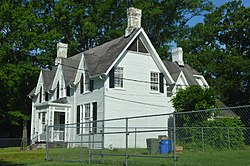
West Nash Street Historic District is a national historic district located at Wilson, Wilson County, North Carolina. It encompasses 79 contributing buildings in a predominantly residential section of Wilson. The district largely developed during the 1910s and 1920s and includes notable examples of Colonial Revival and Bungalow / American Craftsman style architecture. Notable buildings include the William W. Graves House, Selby Hurt· Anderson House, Williams-Cozart House, John T. Barnes House, Graham-Woodard House, M. Douglas Aycock House (1925-1928), John D. Gold House, Boykin's Filling Station, and West End Grocery. It was listed on the National Register of Historic Places in 1984.

Excerpt from the Wikipedia article West Nash Street Historic District (License: CC BY-SA 3.0, Authors, Images).

West Nash Street Historic District
Nash Street Northwest, Wilson

Geographical coordinates (GPS) Address Nearby Places
placeShow on map

Wikipedia: West Nash Street Historic DistrictContinue reading on Wikipedia

Geographical coordinates (GPS)

Latitude Longitude
N 35.738333333333 ° E -77.920555555556 °
placeShow on map

Address

Nash Street Northwest 1115
27893 Wilson
North Carolina, United States
mapOpen on Google Maps

Nash north of Raleigh, Wilson
Share experience

Nearby Places

Wilson, North Carolina

Wilson is a city in and the county seat of Wilson County, North Carolina, United States. It is the 23rd most populous city in North Carolina. Located approximately 40 mi (64 km) east of the capital city of Raleigh, it is served by the interchange of Interstate 95 and U.S. Route 264. Wilson had an estimated population of 49,459 in 2019, according to the U.S. Census Bureau, and is also an anchor city of the Rocky Mount-Wilson-Roanoke Rapids CSA, with a total population of 297,726 as of 2018. In the early 21st century, Wilson was ranked as 18th in size among North Carolina's 500-plus municipalities. From 1990 to 2010, the city population increased by more than 40 percent, primarily due to construction of new subdivisions that attracted many new residents. This has been accompanied by new retail and shopping construction, primarily in the northwestern parts of the city. Wilson is a diverse community; in 2012, the US Census estimated that 48% of the population identified as African American, and 43% as Whites; the remaining 9% includes Latinos and Asians, such as Vietnamese, Chinese and Indians. The U.S. Census Bureau estimated in 2012 that nearly 5,000 county residents (7.5 percent) were foreign-born. Of those, nearly 3,000 people, or 62 percent, had entered the U.S. since 2000. Once a center of tobacco cultivation, the city was widely known as "The World’s Greatest Tobacco Market" in the 19th century. In the 21st century, Wilson enjoys a diverse economy based on agriculture, manufacturing, commercial, and service businesses.