place

Howell-Garner-Monfee House

1906 establishments in ArkansasHouses completed in 1906Houses in North Little Rock, ArkansasHouses on the National Register of Historic Places in ArkansasNational Register of Historic Places in Pulaski County, Arkansas
Pulaski County, Arkansas Registered Historic Place stubs
Howell Garner Monfee House

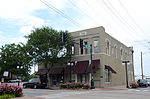
The Howell-Garner-Monfee House is a historic house at 300 West Fourth Street in North Little Rock, Arkansas. It is a 2+1⁄2-story brick structure, with a wide gable roof pierced by gabled dormers. A single-story porch wraps around the east and north sides, with brick posts and a dentil course in the eave. The main entrance is flanked by pilasters and sidelights, with a distinctive transom window that has semi-circular sections joined by a straight section. Built in 1906, it is one of the best-preserved examples of housing built in the city's most fashionable neighborhood of that period.The house was listed on the National Register of Historic Places in 1978.

Excerpt from the Wikipedia article Howell-Garner-Monfee House (License: CC BY-SA 3.0, Authors, Images).

Howell-Garner-Monfee House
Orange Street,

Geographical coordinates (GPS) Address Nearby Places
placeShow on map

Wikipedia: Howell-Garner-Monfee HouseContinue reading on Wikipedia

Geographical coordinates (GPS)

Latitude Longitude
N 34.756944444444 ° E -92.270277777778 °
placeShow on map

Address

Orange Street 383
72114
Arkansas, United States
mapOpen on Google Maps

Howell Garner Monfee House
Share experience

Nearby Places

Argenta Historic District

The Argenta Historic District encompasses significant historic elements of central North Little Rock, Arkansas. The area that is now central North Little Rock was known as Argenta when it was first settled, and remained unincorporated until it was annexed to Little Rock in 1890. William Faucette, a leading Argenta politician and businessman, orchestrated the incorporation of North Little Rock just beyond the annexed area in 1901, and then made a successful petition to separate Argenta from Little Rock into the new municipality in 1903. Subsequent attempts to rename North Little Rock to Argenta have failed.The district consists of two discontinuous areas, one commercial and the other residential. The commercial section consists of a three-block stretch of Main Street, between Broadway Street and 6th Street. Three blocks west of this area is the residential area, which is centered on a stretch of Willow Street from 4th to Melrose Circle, that also includes properties on adjoining blocks of cross streets in between. The district was first listed on the National Register of Historic Places in 1993. In 2002 it was amended to change the status of five buildings to contributing status, as they had undergone appropriate historic restoration work.The commercial section of the district was primarily developed between 1900 and 1940, and includes 18 historically significant buildings, including six that are separately listed on the National Register: North Little Rock City Hall, the former North Little Rock Post Office (now the Argenta Branch Library), the Faucette Building, and the Old Central Fire Station are among them. The residential section includes 177 buildings in total, of which 77 were initially deemed historically significant, including the separately-listed Baker House and Barth-Hempfling House. Many of the non-contributing properties are of an appropriate age, and were only excluded because of the application of inappropriate exterior siding materials and other reversible or restorable alterations. The majority of residential buildings are Craftsman in style, although there are large numbers of vernacular versions of the Colonial Revival present as well.