place

Cypress Lake (Lafayette, Louisiana)

Bodies of water of Lafayette Parish, LouisianaGeography of Lafayette, LouisianaProtected areas of Lafayette Parish, LouisianaReservoirs in LouisianaUniversity of Louisiana at Lafayette
The Swamp 1
The Swamp 1

Cypress Lake is a 2-acre (0.8 ha) swamp-like lake in the heart of the University of Louisiana at Lafayette campus that started as a prehistoric bison wallow. Today it is a unique university landmark that is a habitat for native irises, alligators, turtles, birds and fish, as well as a hangout for students and a point of interest for tourists visiting Lafayette, Louisiana. Cypress Lake is casually called "The Swamp," which is also the nickname of the Louisiana Ragin' Cajuns football stadium, officially named Cajun Field.

Excerpt from the Wikipedia article Cypress Lake (Lafayette, Louisiana) (License: CC BY-SA 3.0, Authors, Images).

Cypress Lake (Lafayette, Louisiana)
Hebrard Boulevard, Lafayette

Geographical coordinates (GPS) Address Nearby Places
placeShow on map

Wikipedia: Cypress Lake (Lafayette, Louisiana)Continue reading on Wikipedia

Geographical coordinates (GPS)

Latitude Longitude
N 30.2136 ° E -92.018 °
placeShow on map

Address

Hebrard Boulevard

Hebrard Boulevard
70503 Lafayette
Louisiana, United States
mapOpen on Google Maps

The Swamp 1
The Swamp 1
Share experience

Nearby Places

McNaspy Stadium

McNaspy Stadium was a 4,500-seat stadium built on the campus of the University of Louisiana at Lafayette (then called Southwestern Louisiana Institute) built in 1940, and remained the home for the school's football team until 1971. The stadium was located to the southwest of Earl K. Long Gymnasium, which had been built the previous year, and consisted of a large home grandstand on the north side and bleachers on the south, with a cinder track surrounded by hedges in the end zones. The grandstand had arches along its top (to reflect the arches in the "arcade" along the Quad, built at roughly the same time), and also contained men's dorm space, weight rooms, locker rooms, etc. The field was oriented in a northeast–southwest direction, mirroring the street grid of the rest of the campus. It was named for the first athletic director and football coach at the university, Clement "C. J" McNaspy. The Camellia Bowl was held there in 1948. Replaced by Cajun Field in 1971, the stadium was demolished in 2000 to make room for Oliver Hall, named after James R. Oliver, who created the computer science department at UL. Oliver Hall houses the university's computer science department. Between 1971 and 2000 the stadium was used by the university's men's soccer team until the mid-1980s, as well as for various other functions. It remained a popular place among students to jog along the track, as well as the stands being used so often as a place to tan on that "McNaspy Beach" was a common nickname. It was also temporarily used by the Pride of Acadiana as a practice field while a new parking garage was built on Hamilton Field, near the Angelle Hall where the music department is located. The band has since returned to a reconfigured Hamilton Field. Recently, trees were planted in the area that used to be mid-field during the McNaspy era, but will now be part of a new "Quad," once the planned buildings are constructed on either side of Oliver Hall.

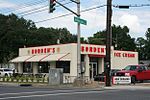
Borden's Ice Cream
Borden's Ice Cream

Borden's Ice Cream Shoppe is a historic ice cream parlor on Johnston Street in Lafayette, Louisiana, built in 1940 to sell Borden ice creams. In 1981, then owner, lifelong Lafayette resident Flora Levy, died. Her will stipulated a large bequest to the University of Louisiana Lafayette's Foundation; the ice cream parlor was part of that bequest. The Foundation held the title to the building, and rented the space to the manager who continued to operate the business. The building had been passed down from generation to generation in the Levy family; Flora had received it from her mother. In May 2009, the Foundation sold the store to Lafayette Red's health club owner Red Lerille, who bought the property with the intention of keeping the local icon alive in Lafayette. Lerille plans to slightly renovate the building, adding a drive through window and outdoor seating. Lerille's daughter Kackie Lerille will manage the store. Lerille was quoted as saying that he is interested in mom-and-pop type businesses like the ice cream store. "I believe it is the American way, but it is dying fast. This location is actually the last Borden’s retail ice cream shop in the United States. It is a Lafayette tradition and my daughter and I fully intend to bring it back to its original state." Ella Mae Meaux—who had worked in the parlor for 48 years by the time it was sold to the Lerille Family—said, "Generations of family have come to Borden's for the old-fashioned ice cream parlor experience. This sale to the Lerilles ensures families will be able to continue with this experience for many years to come."

Council for the Development of French in Louisiana

The Council for the Development of French in Louisiana (CODOFIL; French: Conseil pour le développement du français en Louisiane) is Louisiana's Office of Francophone Affairs (French: Agence des affaires francophones). It is a state agency whose multiple legislative mandates include developing opportunities to use the French language in tourism, economic development, culture, education and international relations. CODOFIL is governed by a board of 23 members and administratively placed within the Louisiana Office of Cultural Development's Department of Culture, Recreation and Tourism, overseen by the Lieutenant Governor. CODOFIL is the only state agency in the United States whose purpose is to serve a linguistic population. Today, CODOFIL's role is to promote and support French immersion and French as a second language in education; it acts as a partner to the Louisiana Department of Education (LDOE), whose role is to manage Louisiana's school districts. CODOFIL continues to recruit and sponsor French, Belgian and Canadian associate teachers as per its accords with those countries, who are placed alongside local teachers upon LDOE's recommendation. CODOFIL encourages Louisiana Francophones to continue transmission of the state's heritage language via its scholarship program (providing opportunities for pedagogical advancement) and the Escadrille Louisiane program (which allows non-native speakers to perfect French at the Université de Rennes in exchange for a minimum 3-year teaching commitment of French in Louisiana).CODOFIL has also worked to instill pride in all Louisiana Francophones in their linguistic identity rather than to uphold one variety of French language or another.