place

Gdańsk Street, Bydgoszcz

Cultural heritage monuments in BydgoszczStreets and squares in BydgoszczVillas in Bydgoszcz
Ulica Gdanska Plac Wolnosci 2023

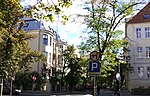
Gdańska Street is one of the main streets of downtown Bydgoszcz, Poland. Initially, the street was a thoroughfare, but in the second half of the 19th century, it turned residential. It ran from the Brda river to Bydgoszcz northern part of town and has gradually become the city center of trade and entertainment. During the interwar period, Gdańska street was the third longest street in Bydgoszcz with a total length of 3.19 km.The street connects the Old Town Road with the northern areas of Bydgoszcz agglomeration. The southern part is the real "vertebrate column" of Bydgoszcz downtown and the most architecturally representative, while the northern part - from the Municipal Stadium to the southern boundaries of the city- is bordered by Forest Park of Culture and Leisure and the Gdańsk Forest. Rich architecturally, Gdańska Street has got many buildings registered on the Kuyavian-Pomeranian Voivodeship Heritage list.

Excerpt from the Wikipedia article Gdańsk Street, Bydgoszcz (License: CC BY-SA 3.0, Authors, Images).

Gdańsk Street, Bydgoszcz
Gdańska, Bydgoszcz

Geographical coordinates (GPS) Address Nearby Places
placeShow on map

Wikipedia: Gdańsk Street, BydgoszczContinue reading on Wikipedia

Geographical coordinates (GPS)

Latitude Longitude
N 53.1611 ° E 18.0394 °
placeShow on map

Address

Gdańska 171
85-674 Bydgoszcz (Osiedle Leśne)
Kuyavian-Pomeranian Voivodeship, Poland
mapOpen on Google Maps

Ulica Gdanska Plac Wolnosci 2023
Share experience

Nearby Places

2010 IAAF World Cross Country Championships

The 2010 IAAF World Cross Country Championships were held at Myślęcinek Park in Bydgoszcz, Poland on 28 March 2010. It was the first time in over twenty years that Poland hosted the annual championships, having previously held them in Warsaw in 1987. Kenyan runners dominated the competition, taking all four individual titles and all four team titles at the competition. Kenyans took the top four spots in both junior men's and junior women's races to finish with a perfect team score.In the absence of Zersenay Tadese and Kenenisa Bekele, the senior men's race was an opportunity for less-established runners. Joseph Ebuya won the gold (his first major medal), becoming the first Kenyan to win the men's race since Paul Tergat in 1999. Teklemariam Medhin of Eritrea took second place (also his first major medal) while Moses Ndiema Kipsiro of Uganda was third. Kenya won the senior men's team gold with ease and Eritrea won the team silver medal. Defending champion Gebregziabher Gebremariam only just made the top ten but led Ethiopia to the team bronze. Florence Kiplagat was not present to defend the women's senior title, leaving Linet Masai and Tirunesh Dibaba as the favourites. However, a sprint finish by little-known runner Emily Chebet rendered Masai the silver medallist for a second year running. Meselech Melkamu of Ethiopia won the fourth World Cross Country bronze of her career as Dibaba finished outside the medals. Kenya and Ethiopia won the team gold and silver, respectively, while Shalane Flanagan led the United States women's team to a bronze medal. The top four in both the junior men and women's races were all Kenyan, with Caleb Mwangangi Ndiku and Mercy Cherono the gold medallists. The dominance of the competition by Kenyan and East African runners was accompanied by a decline in the number of European teams that were entered for the tournament, with some historically strong countries sending no athletes at all.