place

Ministry of Construction of Heavy Industry

AC with 0 elementsHeavy industryPeople's commissariats and ministries of the Soviet UnionSoviet Union stubs

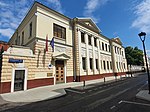
The Ministry of Construction of Heavy Industry of the USSR (Mintyazhstroy; Russian: Министерство строительства предприятий тяжелой промышленности СССР) was a central government institution charged with leading the heavy industry of the Soviet Union. It was established in 1946 to replace the several successor Commissariats to the People's Commissariat of Heavy Industry of the USSR, dissolved in 1939. After liquidation in 1953, it was reactivated from 1967 to 1986.The ministry headquarters was one of the Seven Sisters built during the last 10 years of Stalin's life, also known as the Red Gate building owing to its proximity to the Red Gate Square.

Excerpt from the Wikipedia article Ministry of Construction of Heavy Industry (License: CC BY-SA 3.0, Authors).

Ministry of Construction of Heavy Industry
Садовая-Спасская улица, Moscow Krasnoselsky District

Geographical coordinates (GPS) Address Nearby Places
placeShow on map

Wikipedia: Ministry of Construction of Heavy IndustryContinue reading on Wikipedia

Geographical coordinates (GPS)

Latitude Longitude
N 55.769444444444 ° E 37.649444444444 °
placeShow on map

Address

Садовая-Спасская улица 21/1
107053 Moscow, Krasnoselsky District
Moscow, Russia
mapOpen on Google Maps

Share experience

Nearby Places

Komsomolskaya Square (Moscow)

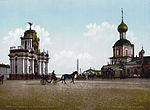
Komsomolskaya Square (Russian: Комсомо́льская пло́щадь), known as Kalanchyovskaya (Russian: Каланчёвская площадь) before 1932, is a square in Moscow, with a blend of revivalist Tsarist and Stalinist architecture. It is referred to informally as Three Station Square (Russian: Пло́щадь трёх вокза́лов; lit. "Ploshchad' tryokh vokzalov") after the three rail termini situated there: Leningradsky, Yaroslavsky, and Kazansky. These stations connect Moscow with Saint Petersburg, northwestern Russia, the Volga region, and Siberia via the Trans-Siberian Railway. Its origins lay with the construction of the Moscow-Saint Petersburg Railway in the 1840s, when Kalanchyovskoye Field outside the Garden Ring was selected to allocate the Nicholas Railway Station (later renamed Leningradsky). In 1862 the Yaroslavsky Rail Terminal, a terminus of the Trans-Siberian Railway, was constructed nearby. On the opposite side of the field the Kazansky Rail Terminal was inaugurated two years later. Until 1909, a railway line leading to Kursky Rail Terminal traversed the square; it is now elevated so as not to interfere with street traffic. During the Soviet period, four other structures were added. Alexey Shchusev designed a Constructivist edifice, the Central Club of Railway Workers, in 1925–1926. The square received its present name, in the honour of the Komsomol (Communist Union of Youth) members, in 1932. A Stalinist skyscraper of the Hilton Moscow Leningradskaya Hotel and a Neoclassical vestibule of the Komsomolskaya-Koltsevaya metro station were completed in the early 1950s. The most recent addition is the Moskovsky department store on the eastern side of the square (1983). In 2003, at the behest of the Ministry of Transportation, a bronze statue of Pavel Melnikov (1804–1880) was erected on the square. Melnikov was the Russian minister of transportation who oversaw the construction of the first railways in Russia.