place

Hilton Moscow Leningradskaya

AC with 0 elementsHilton Hotels & Resorts hotelsHotel buildings completed in 1954Hotels built in the Soviet UnionHotels established in 1954
Hotels in MoscowSeven Sisters (Moscow)Stalinist architecture
2019 07 30 3510 Moscow building

The Hilton Moscow Leningradskaya (Russian: Гостиница Ленинградская) is one of Moscow's Seven Sisters, skyscrapers built in the early 1950s in the Stalinist neoclassical style. Stalinist neoclassical architecture mixes the Russian neoclassical style with the style of American skyscrapers of the 1930s. A main element of Stalinist neoclassicism is its use of socialist realism art. The hotel, completed in 1954, was designed to be the finest luxury hotel in Moscow. The staircase features one of the longest lighting fixtures in the world—it was once in The Guinness Book of Records. The halls and corridors of the hotel's upper floors are panelled in dark cherry wood. The hotel includes a restaurant, bar, lounge, spa and beauty salon, fitness centre with swimming pool, bureau de change, gift shop, meeting rooms, grand ballroom, and business center.The tower of the Hilton Moscow Leningradskaya Hotel dominates Komsomolskaya Square, with its three ornate railway stations (the Leningradsky, Yaroslavsky and Kazansky) located nearby, along with a main ring road of downtown Moscow. The hotel joined the Hilton Hotels chain in 2008 after completing a multimillion-dollar restoration and renovation.

Excerpt from the Wikipedia article Hilton Moscow Leningradskaya (License: CC BY-SA 3.0, Authors, Images).

Hilton Moscow Leningradskaya
Каланчёвская улица, Moscow Krasnoselsky District

Geographical coordinates (GPS) Address External links Nearby Places
placeShow on map

Wikipedia: Hilton Moscow LeningradskayaContinue reading on Wikipedia

Geographical coordinates (GPS)

Latitude Longitude
N 55.773888888889 ° E 37.651666666667 °
placeShow on map

Address

Hilton Moscow Leningradskaya

Каланчёвская улица 21/40
107078 Moscow, Krasnoselsky District
Moscow, Russia
mapOpen on Google Maps

linkWikiData (Q2269257)
linkOpenStreetMap (130850433)

2019 07 30 3510 Moscow building
Share experience

Nearby Places

Komsomolskaya Square (Moscow)

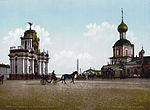
Komsomolskaya Square (Russian: Комсомо́льская пло́щадь), known as Kalanchyovskaya (Russian: Каланчёвская площадь) before 1932, is a square in Moscow, with a blend of revivalist Tsarist and Stalinist architecture. It is referred to informally as Three Station Square (Russian: Пло́щадь трёх вокза́лов; lit. "Ploshchad' tryokh vokzalov") after the three rail termini situated there: Leningradsky, Yaroslavsky, and Kazansky. These stations connect Moscow with Saint Petersburg, northwestern Russia, the Volga region, and Siberia via the Trans-Siberian Railway. Its origins lay with the construction of the Moscow-Saint Petersburg Railway in the 1840s, when Kalanchyovskoye Field outside the Garden Ring was selected to allocate the Nicholas Railway Station (later renamed Leningradsky). In 1862 the Yaroslavsky Rail Terminal, a terminus of the Trans-Siberian Railway, was constructed nearby. On the opposite side of the field the Kazansky Rail Terminal was inaugurated two years later. Until 1909, a railway line leading to Kursky Rail Terminal traversed the square; it is now elevated so as not to interfere with street traffic. During the Soviet period, four other structures were added. Alexey Shchusev designed a Constructivist edifice, the Central Club of Railway Workers, in 1925–1926. The square received its present name, in the honour of the Komsomol (Communist Union of Youth) members, in 1932. A Stalinist skyscraper of the Hilton Moscow Leningradskaya Hotel and a Neoclassical vestibule of the Komsomolskaya-Koltsevaya metro station were completed in the early 1950s. The most recent addition is the Moskovsky department store on the eastern side of the square (1983). In 2003, at the behest of the Ministry of Transportation, a bronze statue of Pavel Melnikov (1804–1880) was erected on the square. Melnikov was the Russian minister of transportation who oversaw the construction of the first railways in Russia.

Komsomolskaya (Sokolnicheskaya line)

Komsomolskaya (Russian: Комсомо́льская) is a Moscow Metro station in the Krasnoselsky District, Central Administrative Okrug, Moscow. It is on the Sokolnicheskaya line, between Krasnye Vorota and Krasnoselskaya stations. It is located under Komsomolskaya Square, between the Leningradsky, Yaroslavsky, and Kazansky railway terminals. The station was named for the workers of the Komsomol youth league who helped to construct the first Metro line. It has a transfer at its namesake on the Koltsevaya line. Komsomolskaya was built using the cut and cover method, with construction beginning on 3 May 1933. Temporary bridges were built over the construction site to avoid disrupting traffic, especially the numerous tram routes in the area. To counteract the high water table, the station was built on 636 piles which were driven into the saturated soil. Heavy rains in the summer of 1934 threatened the construction site several times, and at one point even the Kazansky terminal was in danger of collapsing. Nevertheless, the concrete structure of the station was completed by August 26 and Komsomolskaya opened on schedule on May 15, 1935. Due to Komsomolskaya's location under a major transit hub, the station was built with an unusual upper gallery above the platform to help handle rush crowds. The station has tall pillars faced with pinkish limestone and topped with bronze capitals displaying the emblem of the Komsomol league. The station was designed by Dmitry Chechulin, and a model of it was displayed at the 1937 Paris World's fair. The station's southern entrance vestibule is built into the Kazansky Rail Terminal. The northern vestibule is on the opposite side of the square, between the Leningradsky and Yaroslavsky rail terminals. The latter entrance did not survive in its original form, having been replaced with a massive structure serving both this station and the Koltsevaya line station in 1952. There is a short branch line between Komsomolskaya and Krasnoselskaya stations, that leads to the Severnoe Depot. On 15 October 1934 the first Metro train left this depot for a trial run.