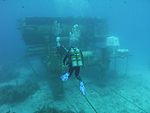
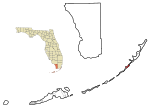
NASA Extreme Environment Mission Operations, or NEEMO, is a NASA analog mission that sends groups of astronauts, engineers and scientists to live in the Aquarius underwater laboratory, the world's only undersea research station, for up to three weeks at a time in preparation for future space exploration.Aquarius is an underwater habitat 3.5 miles (5.6 km) off Key Largo, Florida, in the Florida Keys National Marine Sanctuary. It is deployed on the ocean floor next to deep coral reefs 62 feet (19 m) below the surface.
NASA has used it since 2001 for a series of space exploration simulation missions, usually lasting 7 to 14 days, with space research mainly conducted by international astronauts. The mission had cost about 500 million U.S. dollars. The crew members are called aquanauts (as they live underwater at depth pressure for a period equal to or greater than 24 continuous hours without returning to the surface), and they perform EVAs in the underwater environment. A technique known as saturation diving allows the aquanauts to live and work underwater for days or weeks at a time. After twenty four hours underwater at any depth, the human body becomes saturated with dissolved gas. With saturation diving, divers can accurately predict exactly how much time they need to decompress before returning to the surface. This information limits the risk of decompression sickness. By living in the Aquarius habitat and working at the same depth on the ocean floor, NEEMO crews are able to remain underwater for the duration of their mission.
For NASA, the Aquarius habitat and its surroundings provide a convincing analog for space exploration.
Much like space, the undersea world is a hostile, alien place for humans to live. NEEMO crew members experience some of the same challenges there that they would on a distant asteroid, planet (i.e. Mars) or Moon. During NEEMO missions, the aquanauts are able to simulate living on a spacecraft and test spacewalk techniques for future space missions. Working in space and underwater environments requires extensive planning and sophisticated equipment. The underwater condition has the additional benefit of allowing NASA to "weight" the aquanauts to simulate different gravity environments.Until 2012, Aquarius was owned by the National Oceanic and Atmospheric Administration (NOAA) and operated by the National Undersea Research Center (NURC) at the University of North Carolina–Wilmington as a marine biology study base.
Since 2013, Aquarius is owned by Florida International University (FIU). As part of the FIU Marine Education and Research Initiative, the Medina Aquarius Program is dedicated to the study and preservation of marine ecosystems worldwide and is enhancing the scope and impact of FIU on research, educational outreach, technology development, and professional training. At the heart of the program is the Aquarius Reef Base.

 Continue reading on Wikipedia