place

Nageshvara Temple, Begur

9th-century Hindu templesHindu temples in Bangalore Rural districtKannada inscriptionsUse Indian English from December 2019
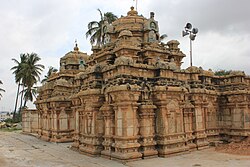
Naganatheshvara Temple (9th century) at Begur, Bengaluru

The Nageshvara temple complex (also spelt Nagesvara and called Naganatheshvara locally) is located in Begur, a small town within the Bangalore urban district of Karnataka state, India. From inscriptions, it is known that Begur was once called Veppur, and Kelele (in Western Ganga King Durvinita's Mollahalli grant inscription of 580-625 C.E.). Two shrines within the temple complex, the Nageshvara and Nageshvarasvami were commissioned during the rule of Western Ganga Dynasty Kings Nitimarga I (also called Ereganga Neetimarga, r. 843-870) and Ereyappa Nitimarga II (also called Ereganga Neetimarga II, r. 907-921). The remaining shrines are considered a later day legacy of the rule of the Chola Dynasty over the region. An Old Kannada inscription, dated c. 890, that describes a "Bengaluru war" (modern Bangalore city) was discovered in this temple complex by the epigraphist R. Narasimhachar. The inscription is recorded in "Epigraphia Carnatica" (Vol 10 supplementary). This is the earliest evidence of the existence of a place called Bengaluru.

Excerpt from the Wikipedia article Nageshvara Temple, Begur (License: CC BY-SA 3.0, Authors, Images).

Nageshvara Temple, Begur
Bengaluru Beguru (Bommanahalli Zone)

Geographical coordinates (GPS) Address Nearby Places
placeShow on map

Wikipedia: Nageshvara Temple, BegurContinue reading on Wikipedia

Geographical coordinates (GPS)

Latitude Longitude
N 12.87674 ° E 77.62671 °
placeShow on map

Address


583105 Bengaluru, Beguru (Bommanahalli Zone)
Karnataka, India
mapOpen on Google Maps

Naganatheshvara Temple (9th century) at Begur, Bengaluru
Share experience

Nearby Places

Inscription stones of Bengaluru

Inscription stones of Bengaluru refers to numerous historical stone plaques, tablets, and rock carvings bearing inscriptions (epigraphs) and sometimes sculptures (such as hero stones) found throughout the Bengaluru metropolitan area in Karnataka, India. Within the limits of the modern Bruhat Bengaluru Mahanagara Palike, approximately 175 such stones have been documented in various historical surveys and publications. These artifacts, dating from the Ganga dynasty period (c. 4th century CE) through the Chola, Hoysala, Vijayanagara, Maratha, Mysore Kingdom, and British periods up to the early 20th century, provide invaluable primary source material for understanding the region's history, toponymy, language evolution, socio-religious practices, and administrative structures. They include various types, such as Vīragallu (hero stones), grant inscriptions (recording donations of land or taxes), temple inscriptions, royal decrees, Nisidhi stones (Jain memorials), and records of construction activities. Written predominantly in Kannada and Tamil languages and scripts, with some examples in Telugu, Sanskrit, Grantha, and Persian, these inscriptions are distributed across numerous historical localities within modern Bengaluru, including Begur, Hebbal, Malleshwaram, Kodigehalli, Domlur, and Yelahanka. Within the limits of the modern Bruhat Bengaluru Mahanagara Palike, approximately 175 such stones have been documented in various historical surveys and publications.Notable discoveries include the Begur inscription (c. 890 CE), which contains the earliest known written reference to the name "Bengaluru". Systematic documentation began with B. Lewis Rice's Epigraphia Carnatica in the late 19th century, followed by publications from the Mysore Archaeological Department and others. However, rapid urbanization, neglect, and weathering pose significant threats to the survival of these artifacts. Preservation efforts are undertaken by governmental bodies like the Karnataka State Department of Archaeology, Museums and Heritage, alongside non-governmental organizations such as The Mythic Society, INTACH Bengaluru Chapter, and citizen initiatives like the 'Inscription Stones of Bengaluru' project, which focuses on discovery, documentation, digital preservation, and raising public awareness.

Begur inscriptions and hero stones

The Begur inscriptions and hero stones are significant archaeological and epigraphical artifacts located primarily in Begur, a locality within the Bengaluru South taluk. Spanning a period from the Western Ganga dynasty (c. 6th-10th centuries CE) through the Chola and later periods (up to the 16th century CE), these artifacts are crucial for understanding the early history of Bengaluru. Notably, a 9th/10th-century inscription found here contains the earliest known written reference to "Bengulooru" (Bengaluru), challenging later narratives about the city's founding. The inscriptions and hero stones, mainly concentrated within the Panchalingeshwara Temple complex (also known as Nageshvara Temple), provide valuable insights into the region's political history, including the rule of the Western Gangas and Cholas, administrative divisions like Bempur-naadu, and local conflicts. They also illuminate diverse religious practices, revealing the co-existence and patronage of both Hinduism (specifically Shaivism) and Jainism, evidenced by temple grants and records of the sallekhana ritual. Furthermore, the artifacts shed light on socio-cultural aspects, such as the veneration of heroes (viragallu), community rituals, and the evolution of the Kannada and Tamil languages in the area. Ongoing conservation efforts, including digital preservation initiatives, aim to safeguard these irreplaceable links to Bengaluru's past.