place

Oscar Anderson House Museum

Alaska Registered Historic Place stubsAlaska building and structure stubsAnchorage, Alaska geography stubsBuildings and structures on the National Register of Historic Places in Anchorage, AlaskaHistoric house museums in Alaska
Houses completed in 1915Houses in Anchorage, AlaskaHouses on the National Register of Historic Places in AlaskaMuseums in Anchorage, AlaskaUse mdy dates from August 2023Western United States museum stubs
Oscar Anderson House

The Oscar Anderson House Museum is a historical museum at 420 M Street in downtown Anchorage in the U.S. state of Alaska. Located in Elderberry Park, the structure was built in 1915 by early Anchorage resident Oscar Anderson. Anderson claimed to be the 18th person to set foot on what is now Anchorage. The structure was the first wood-frame house in Anchorage, and was occupied by Anderson until his death in 1974. The house was completely restored to a 1915 appearance between 1978 and 1982, and is now open as a historic house museum. It was listed on the National Register of Historic Places in 1978.

Excerpt from the Wikipedia article Oscar Anderson House Museum (License: CC BY-SA 3.0, Authors, Images).

Oscar Anderson House Museum
Tony Knowles Coastal Trail, Anchorage

Geographical coordinates (GPS) Address Nearby Places
placeShow on map

Wikipedia: Oscar Anderson House MuseumContinue reading on Wikipedia

Geographical coordinates (GPS)

Latitude Longitude
N 61.218611111111 ° E -149.90611111111 °
placeShow on map

Address

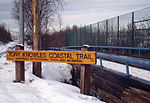
Tony Knowles Coastal Trail

Tony Knowles Coastal Trail
99501 Anchorage
Alaska, United States
mapOpen on Google Maps

Oscar Anderson House
Share experience

Nearby Places

Oscar Gill House
Oscar Gill House

The Oscar Gill House is a historic house at 1344 West Tenth Avenue in the South Addition neighborhood of Anchorage, Alaska. It is one of Anchorage's oldest buildings. It is a two-story wood-frame structure, three bays wide, with a side gable roof. The bays are asymmetrically arranged, with a single-window bay on the right and a double-window bay on the left. The center bay is taken up by a projecting gable-roofed vestibule, in which the door is slightly off-center. The house's modest Craftsman style includes extended eaves with exposed rafter ends, and it has retained original interior flooring and woodwork. The house was built in 1913 by Oscar Gill in the (now ghost) town of Knik at the head of Knik Arm. When Anchorage was established in 1916, Gill had the house barged across the inlet, and it stood at 918 West Tenth Avenue for many decades. The house was removed from that site in 1982 to accommodate expansion of the Anchorage Pioneer Home, one of many historic houses throughout downtown Anchorage which fell victim to a real estate and building boom that intensified in 1982 and 1983. Unlike other similar structures, most of which spent years in storage on municipally-owned land but were eventually demolished, this house was spared. It sat on a vacant lot on P Street, across from the western end of the Delaney Park Strip, for approximately a decade and a half before being moved to its present location. The house has been operated as a bed and breakfast establishment since that time. The house was listed on the National Register of Historic Places in 2001.

Fourth Avenue Theatre (Anchorage, Alaska)

The Fourth Avenue Theatre, also known as the Lathrop Building, was a movie theater in Anchorage, Alaska that has been described as Art Deco, Streamline Moderne, and Art Moderne in style. Built beginning in 1941 and completed in 1947 after a halt during World War II, somewhat after the heyday of these styles, it was a large 960-seat first-run theater until the 1980s. The theater was designed by B. Marcus Priteca, a leading designer of themed cinemas in America, in association with Seattle architect A.A. Porreca for Cap Lathrop, a prominent Alaska businessman. The theater's lobby featured a gold leaf mural of Mount McKinley, but originally omitted a concession stand, a feature Lathrop felt was inappropriate. The main house was decorated with silver and gold murals by Anthony Heinsbergen and Frank Bouman of Los Angeles, and a rendering of the Big Dipper (a symbol of Alaska) on the ceiling. Murals were done on canvas with reliefs in Masonite leafed with gold and silver. The building's structure is reinforced concrete with travertine on the exterior street level. As the Lathrop Building, the complex included facilities for Lathrop's radio and television stations, a restaurant, and a penthouse apartment added in 1959-1960. After some renovation by the city of Anchorage, the theater was used by a catering firm as a banquet facility. Rasmuson Foundation approved a program related investment structured as a low-interest loan to the Municipality of Anchorage in 2006 so that the city could purchase, restore and use the Theater for meeting space by the Anchorage Convention and Visitors Bureau. When the Anchorage Assembly voted to prohibit the City to act as the loan guarantor, Rasmuson Foundation rescinded the award offer. Due to the economic recession in the following years, these plans did not come to fruition. In 2011, the theater's new owner, Peach Investments, presented new restoration plans.In a press conference on May 17, 2022, Anchorage mayor Dave Bronson announced his support for a near-complete redevelopment of the entire city block including the theater building. The proposal would include demolition of the theater building by owner Peach Holdings, LLC, which owns all but one corner parcel on the block between Fourth and Fifth Avenues and F and G streets. However, the plan for the anticipated $200 million multi-use project includes partial reconstruction of the theater's facade and signage. It was demolished in late 2022.