place

Mississippi State Capitol

1901 establishments in MississippiGovernment buildings on the National Register of Historic Places in MississippiGovernment buildings with domesGovernment of MississippiMississippi Landmarks
National Historic Landmarks in MississippiNational Register of Historic Places in Jackson, MississippiState capitols in the United StatesTourist attractions in Jackson, MississippiUse mdy dates from September 2019
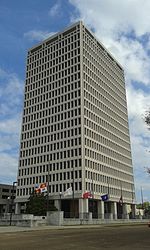
Jackson December 2018 02 (Mississippi State Capitol)

The Mississippi State Capitol or the “New Capitol,” has been the seat of the state’s government since it succeeded the old statehouse in 1903. Located in Jackson, it was designated as a Mississippi Landmark in 1986, a National Historic Landmark in 2016 and added to the National Register of Historic Places in 1969.

Excerpt from the Wikipedia article Mississippi State Capitol (License: CC BY-SA 3.0, Authors, Images).

Mississippi State Capitol
Mississippi State Capitol Walking Path, Jackson

Geographical coordinates (GPS) Address Nearby Places
placeShow on map

Wikipedia: Mississippi State CapitolContinue reading on Wikipedia

Geographical coordinates (GPS)

Latitude Longitude
N 32.303888888889 ° E -90.182222222222 °
placeShow on map

Address

Mississippi State Capitol Walking Path

Mississippi State Capitol Walking Path
Jackson
Mississippi, United States
mapOpen on Google Maps

Jackson December 2018 02 (Mississippi State Capitol)
Share experience

Nearby Places

Supreme Court of Mississippi

The Supreme Court of Mississippi is the highest court in the state of Mississippi. It was established in 1818 per the terms of the first constitution of the state and was known as the High Court of Errors and Appeals from 1832 to 1869. The court is an appellate court. It is housed in the Carroll Gartin Justice Building in Jackson, Mississippi, the state capital. The court consists of nine justices elected in nonpartisan contests from three different districts to serve eight-year terms. The justice most senior in tenure serves as the chief justice. The state constitution grants the Supreme Court broad jurisdiction to review cases that raise questions of law. It only has original jurisdiction over legal cases arising from actions taken by the Mississippi Public Service Commission to alter utility rates and in investigating instances of judicial misconduct. State law gives the Supreme Court direct appellate jurisdiction over cases involving capital punishment, municipal annexation, bond issues, election disputes, judicial disciplinary affairs, certified questions from federal courts, and laws found unconstitutional in lower courts. All appeals of state trial court rulings concerning other matters are initially brought before the Supreme Court, which can then assign them to the Mississippi Court of Appeals at its discretion. The court's members are divided into "divisions" of three justices each, and most cases are heard and ruled upon only by one division. The justices sit en banc to review split-decisions from a division—at the dissenting justice's request—and to hear cases involving capital punishment, utility rates, constitutional matters of first impression, and issues deemed to likely have a significant impact on the public.

Sun-n-Sand Motor Hotel

The Sun-n-Sand Motor Hotel was a motel in Jackson, Mississippi, United States. The motel was opened in 1960 and partially demolished in 2021. The motel was opened by Mississippi businessman Dumas Milner and was designed in either the International or mid-century modern style. Due to its close proximity to the Mississippi State Capitol, the motel served as the temporary lodging for many politicians and elected officials while the Mississippi Legislature was in session. Additionally, during the 1960s, it became a prominent lodging location for activists in the civil rights movement, such as Robert L. Carter of the NAACP and several members of the Council of Federated Organizations during the Freedom Summer project. In either 2001 or 2002, the motel closed. Following this, the government of Mississippi leased the property as a parking lot for government employees. In 2019, the government purchased the property and announced plans to demolish the building and convert the lot into additional parking spaces. This prompted outcry from many state historians and led to the motel being declared a Mississippi Landmark by the Mississippi Department of Archives and History and being added to the National Trust for Historic Preservation's list of America's Most Endangered Places in 2020. Despite this, much of the structure was demolished by February 2021, with only the sign and some of the commons areas preserved, with the intent of converting the latter into office and meeting spaces.