place

Carnegie Library (Lawton, Oklahoma)

1922 establishments in OklahomaBuildings and structures in Comanche County, OklahomaCarnegie libraries in OklahomaLibraries on the National Register of Historic Places in OklahomaLibrary buildings completed in 1922
National Register of Historic Places in Comanche County, OklahomaNeoclassical architecture in OklahomaOklahoma Registered Historic Place stubs
Carnegie library lawton ok

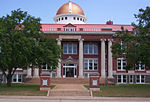
The Carnegie Library in Lawton, Oklahoma is a Carnegie library building from 1922. It was listed on the National Register of Historic Places in 1976.It is built of buff-tan brick with white limestone used for window trim and other ornamentation.It was originally a 52 by 52 feet (16 m × 16 m) square plan building, but a 1952 extension added 40 feet (12 m) to the north side.

Excerpt from the Wikipedia article Carnegie Library (Lawton, Oklahoma) (License: CC BY-SA 3.0, Authors, Images).

Carnegie Library (Lawton, Oklahoma)
Southwest B Avenue, Lawton

Geographical coordinates (GPS) Address Nearby Places
placeShow on map

Wikipedia: Carnegie Library (Lawton, Oklahoma)Continue reading on Wikipedia

Geographical coordinates (GPS)

Latitude Longitude
N 34.606666666667 ° E -98.394444444444 °
placeShow on map

Address

Southwest B Avenue

Southwest B Avenue
73502 Lawton
Oklahoma, United States
mapOpen on Google Maps

Carnegie library lawton ok
Share experience

Nearby Places

Lawton, Oklahoma
Lawton, Oklahoma

Lawton is a city in and the county seat of Comanche County, in the U.S. state of Oklahoma. Located in southwestern Oklahoma, approximately 87 mi (140 km) southwest of Oklahoma City, it is the principal city of the Lawton, Oklahoma, metropolitan statistical area. According to the 2020 census, Lawton's population was 90,381, making it the sixth-largest city in the state, and the largest in Western Oklahoma.Developed on former reservation lands of the Kiowa, Comanche, and Apache Indians, Lawton was founded by European Americans on 6 August 1901. It was named after Major General Henry Ware Lawton, who served in the Civil War, where he earned the Medal of Honor, and was killed in action in the Philippine–American War. Lawton's landscape is typical of the Great Plains, with flat topography and gently rolling hills, while the area north of the city is marked by the Wichita Mountains. The city's proximity to the Fort Sill Military Reservation, formerly the base of the Apache territory before statehood, gave Lawton economic and population stability throughout the 20th century.Although Lawton's economy is still largely dependent on Fort Sill, it has grown to encompass manufacturing, higher education, health care, and retail. The city has a council-manager government; the city council members are elected from single-member districts and the mayor is elected at-large. They hire a professional city manager to direct daily operations. Interstate 44 and three major United States highways serve the city, while Lawton-Fort Sill Regional Airport connects Lawton by air. Recreation can be found at the city's many parks, lakes, museums, and festivals. Notable residents of the city include many musical and literary artists, as well as several professional athletes.